So, some things are happening regarding Neil Gaiman (Gaiman) – the formerly beloved fantasy author whose reputation when up in flames when multiple women came forward with stories of coercion into sexual and physical abuse.
One of these women, Scarlett Pavlovich, (Pavlovich) had initially been introduced to him by Amanda Palmer, (Palmer) and was employed by the couple as a nanny. In addition to supplying a truly horrifying story involving physical abuse with a belt, being assaulted in front of the child and non-consensual urine-play – she has sued Gaiman in the US.1Pavlovich, Scarlett v. Gaiman, Neil, 3:25-cv-00078, (W.D. Wis.)
Currently the case against Gaiman is on appeal after the judge dismissed it without prejudice – essentially claiming that the first course of action should be to try to sue Gaiman in New Zealand.2Scarlett Pavlovich v. Neil Gaiman, 25-2754, (7th Cir.) I have opinions on this ruling, but was waiting to see how it played out – but then a plot twist occurred.
In the background there has a been a Substack account frantically gathering evidence and building theories as to why Gaiman is innocent.3Technopathy “Neil Gaiman Is Innocent: Introduction” (10 January 2026) Substack <technopathology.substack.com> It was recently signal boosted by Gaiman as “reporting”.4Neil Gaiman (3 February 2026) BlueSky <bsky.app>
Apparently the author has been identified by his own trail of online breadcrumbs, according to Diana Sterling Jones, he is a buddhist monk who got infamous for various protests – including the Extinction Rebellion that Gaiman supported.5 Diana Sterling Jones “Revealed: Neil Gaiman’s Anonymous Substack Defender is an Activist Monk” (5 February 2026) Shooting The Messenger <shootingthemessenger.blog>
I don’t think I need to explain that the contents of the Substack are bad. It couldn’t be anything but. It complains sources are too vague, or too long – but then the “short reads” are pages upon pages (I picked one at random and it’s more then 3,600 words) and that what they really needed was 46 pages of private messages (because those definitely confirm what happened in real life).6 “Neil Gaiman Is Innocent: Introduction”, above n 3
Technopathology “Neil Gaiman Is Innocent: Contents 2026” (11 July 2025, updated frequently) Substack <technopathology.substack.com> Many of them are clearly desperation and grasping for any straw they think will generate sympathy.
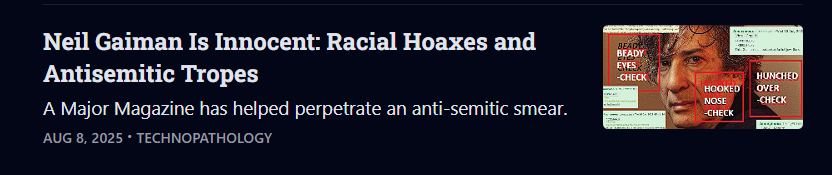
The above is roughly 1,000 words of analysing the professional headshot that Vulture chose for an article and inventing ways that its racist – while using similar headshots on the same blog and making similar decisions regarding the other parties they report on.7Technopathology “Neil Gaiman Is Innocent: Racial Hoaxes and Antisemitic Tropes” (8 August 2025) <technopathology.substack.com> Also, this Substack was started in April 2025 so they should know about the issues there.8Shane Burley “How Deep Does Substack’s Far-Right Problem Run, Really?” (21 June 2024) Ink Stick Media <inkstickmedia.com>
Going over them point by point would be a Sisphean task for even the most passionate and manic investigator. I think everything worth saying about it in general, has already been said by the amazing D’Angelo.9 D’Angelo (@d-angelo) “neil gaiman is back and creepier than ever” (5 February 2026) YouTube <www.youtube.com>
So instead, I want to just examine how far this plea of consent would go in New Zealand – whether there’s a realistic basis that Gaiman would engage with proceedings taking place in New Zealand, and what legal issues might influence his decision to or not to.
Disclaimer: I have a law degree in New Zealand, but I’m not (yet) a lawyer and more importantly I’m not your lawyer. This is a purely amateur analysis. None of this is personal legal advice and you must not rely upon it as such. And please, please, please, do not tell me about any crimes you may have committed.
Also I believe the women who raised the allegations against Gaiman.
I. CONSENT TO HARM IN NEW ZEALAND
As some of my kinkster friends seem to be aware, New Zealand as a jurisdiction does not allow an individual to simply provide consent to personal harm. While their concern for this that various kinky playtime activities can never be completely legal, that has never actually been tested. Certainly no cop, prosecutor or judge is eager to have a prolonged trial about whether the net gratification from kink makes it a public good.
The framework in New Zealand is that consent to serious personal harm can only be granted where there is a strong public policy to allow it. This is what makes it lawful for doctors to perform surgery, the All Blacks to play rugby, boxers to fight each other, and martial arts clubs to operate, etc.10 R v Lee [2006] NZCA 60; [2006] 3 NZLR 42, at [311]-[318] & [337]
A. Public Policy
Since public policy is the naturalistic idea that certain things are simply good for society, it is always messy. As mentioned above, it is understood that certain actions like surgery and sports fall neatly within it, but there have been numerous cases in New Zealand where it was disputed.
Perhaps the most dramatic was the death of Joanna Lee, which raised the question of whether or not freedom to engage in dangerous practices as part of one’s own faith was a public good.11Above Notably though, this did rely upon the plea that the exorcist in question was trying to help Ms Lee – he didn’t intend to harm her, he just felt the risk was inherent in helping her and that it was possible all parties had consented to it in good faith.12Above, at [338]-[339]
More relevant to the Gaiman case is R v S, in which was covered in my Criminal Law classes, in which S was a 38-year old man defending his decision to break his 16-year old partner’s finger with a paving brick and a hammer on the basis that she consented to it.13 R v S [2016] NZHC 1185
As you’ve probably guessed, it turned out the teenage girl in question was in a very vulnerable position. Specifically she was given the alternatives of becoming unhoused or letting her benefactor break her finger.14 Above, at [2]-[5] She was also not a perfect victim – in fact she had admitted to her partner and the police she’d done some serious crimes.15 Above, at [3]
In this decision, the court stressed several things: 16Above, at [24]
- This was an instance of domestic violence, and that was definitely reviled by society so there could not be a public policy supporting it; and
- It was against public policy to allow the dominant partner in a relationship with a clear power imbalance to exploit that to obtain consent to harm; and
- Where the victim has a history of mental illness or self-harm – it was again against public policy to allow the dominant partner to lever that obtain consent.
So, not exactly indicative of your average kinky couple – but how does it apply to the Gaiman / Pavlovich situation?
B. The Gaiman / Pavlovich situation
Pavlovich was not a teenager at the time, but she was still at a substantial imbalance with Gaiman given she was 22 at the time and essentially unhoused (couch surfing, etc). So she was 6 years older than the victim is R v S, but the age and wealth gap was greater, and Pavlovich had also dropped out of high school was trying to complete her education at the time.17 Lila Shapiro “There Is No Safe Word” (13 January 2025) Vulture <www.vulture.com>
She also had a parasocial connection to Palmer that seems to have been a factor in her exploitation.18“There Is No Safe Word”, above There is a case against Palmer too, but her defence is also she wasn’t involved to a capacity she should be legally liable.19Pavlovich v. Palmer, 1:25-cv-10263, (D. Mass.), Document #12 Pavlovich also had a history of being abused and exploited by men Gaiman’s age, was sexually inexperienced and not attracted to men – all of which she disclosed to Gaiman.20“There Is No Safe Word”, above n 17
The dismissed complaint states that Pavlovich was subjected to traumatizing abuse involving sexual assault, being whipped in sensitive regions with belt, and humiliated in a variety of shocking ways. That it was extremely traumatizing is not disputed by the court.21 Pavlovich, Scarlett v. Gaiman, Neil, above n 1, Document #54, at 5-8
Even if Pavlovich testified in court under oath that she had in fact consented to all of his – it is extremely unlikely that any argument could be made that there was prevailing public policy to allow a millionaire to exploit an unhoused, vulnerable woman 20 years his junior in a transitional period of her life, who has a history of abuse and has advised him she would not attracted to him to traumatize her through ongoing abuse.22R v S, above, n 13
II. REMEDIES
New Zealand pioneered a form of nationalized accident insurance which, among other things, has greatly changed how cases like this are handled. This is important as it does specifically cover claims involving sexual violence and has essentially removed the tort of personal injury from New Zealand law.
A. Accident Compensation
Everyone who is injured in the vast majority of kinds of accidents in New Zealand is automatically eligible for cover and assistance under the Accident Compensation Act 2001. This service is provided by the crown entity Accident Compensation Corporation (ACC).
ACC does have special protocols for dealing with harms caused by sexual violence, which recognizes that it does not necessarily have to physical harm to be traumatic and does not require there to be a finding of criminal conviction or even the ability to form criminal intent.23 Accident Compensation Act, s 21
So, ordinarily you can’t sue someone for traumatizing you via sexual assault but you also don’t need them to be criminal prosecuted. However, there is a potential exception – exemplary damages.24 Accident Compensation Act, s 219
B. Exemplary Damages
Exemplary damages are those which the court assigns as a punitive manor – that is they are not intended to compensate the injured party but rather create a deterrent to `the harmful behaviour. It is recognized as similar, but different to criminal law – and the presence of a criminal sentence, or an acquittal, can be relevant.25 Daniels v Thompson [1998] NZCA 3; [`1998] 3 NZLR 22
As Gaiman was never criminally prosecuted, a New Zealand court would be at liberty to assign exemplary damages if it finds that:
a) It believes Gaiman deserves to be punished for his actions; and
b) There is no criminal factor involved at the time of ruling; and
c) He is served for proceedings no later than 4 February 2028 (to capture every wrong doing from the first encounter onward).26 Limitations Act 2010, s 11
Exemplary damages in New Zealand don’t tend to run into US lawsuit numbers – so would be unlikely to run into the claimed $1,000,000 US+ in the initial complaint. That said, this is potentially the first time that we have had a case with this uniquely terrible combination of specifics performed by a millionaire who seems to be demonstrating a distinct lack of remorse – so it could be a first.
There is, however, a distinct possibility that he could get a discount on damages if he had come to New Zealand (which is, by now, doubtlessly offset by the legal fees to avoid proceedings in the USA).
III. CRIMES
Now, police in New Zealand did not opt to prosecute Gaiman at the time, but could they? And if so, what could they charge him with. Would the argument of consent, supported by the endless testimony of a semi-anonymous Substack account, help there? Or his likelihood of willingly returning to New Zealand?
A. Crimes Against Morality and Decency
The full title of Part 7 of the Crimes Act 1961 is “Crimes against morality and decency, sexual crimes, and crimes against public welfare”.
Much like other archaic laws, it has a definition of “rape” that requires a penis but then kind of nullifies that by lumping that with “sexual connection” into the same charge of “sexual violation”.27 Crimes Act 1961, s 128 It specifies that there are conditions where allowing the sexual activity does not amount to consent, and these include the fear of application of force, or where they are mistaken as to the nature of what is going on, or any other reason the court finds consent is not present.28 Crimes Act, s 128A
The maximum sentence for Sexual Violation is 20 years.29 Crimes Act, s 128B This makes it a Category 3 offense, which means it could be tried in the District Court (the lowest category of general court in New Zealand) by a judge-only or a jury if the defendant requests it.30 Criminal Procedure Act 2011, ss 6 & 50
The 20 year sentence also means that, due to the seriousness of this category 3 offence, it can be charged at any time. The statute of limitations never expires.31 Criminal Procedure Act, ss 6 & 25
B. Crimes Against The Person
Part 8 of the Crimes Act, “Crimes against the person” lays out the laws for assaults, murders and the like.
The most obvious charge that Gaiman could face would be Common Assault, which has a maximum sentence of 1 year.32 Crimes Act, s 196 This makes it a Category 2 offence.33 Criminal Procedure Act, s 6 For ordinary charging, the window for prosecution has already closed (being 12 months) – so any prosecution would require prior consent from the Solicitor-General (part of the executive branch of New Zealand) for an absolute maximum of 5 years after the act.34 Criminal Procedure Act, s 25
There is also, depending on the specifics that I do not have and do not want to investigate, potential for the beatings with belts and any other toys to be classified as Assault with a weapon.35 Crimes Act, 202C I was able to find multiple recent cases where domestic violence involving a belt was successfully prosecuted as such, and were unchallenged for such at the Court of Appeal.36 S v R [2020] NZCA 321
T v R [2018] NZCA 342
C v R [2017] NZCA 58 This has a maximum sentence of 5 years, making it a serious category 3 offence – and one that can be charged at any time.37 Criminal Procedure Act, ss 6 & 25
And just to repeat, while Gaiman could plead “consent” as a defence but I very much do not like his chances of convincing the court that public policy supports his argument.
This creates the situation where the police would be incentivised to seek to charge under the more serious charge to simplify matters. So it doesn’t seem like New Zealand will be seeing any more visits from Gaiman.
IV. TIKANGA
While 1-to-1 translations are never perfect, tikanga can essentially be understood to be the Māori system of law, its jurisprudence and philosophy about “what is right”. It has become a major part of New Zealand law since the Supreme Court ruling that tikanga was a constitutional element and thus they would allow a criminal appeal of to continue on after the passing the appellant – for the sake of his mana (respect and honour).38Ellis v R [2022] NZSC 114
I certainly do not consider myself an expert on this, I was 2 years into my law degree when this ruling came out so most of the classes afterwards said “we’ll see how it impacts things”, my Te Reo Māori is abysmal and I don’t engage with any Māori communities to any degree where I would know about the specifics of their practices. But I understand a few things.
One important point that is stressed in everything I have read on tikanga is the sacredness of the body. A major difference explained in law school was that rape had a harsh penalty (often death) in Māori groups not only because of the cruelty, but because in doing so they had violated the sacredness of the victim’s body, and thus their person.
I have not seen the elements of consent explored, but I know that a strong component of such discussions is what the people consider tika (correct, or righteous). I cannot imagine any person of great mana arguing that the way Gaiman approached Pavlovich, treated her in their relationship and has acted since to be tika.
Combine this with the general way Gaiman has been evasive and disrespectful to Pavlovich, especially with this recent presenting conspiracy rants undermining her and other victims – and it seems clear that tikanga would also consider these to be extremely serious offences.
V. CONCLUSION
The “Neil Gaiman is Innocent” approach has done nothing to establish his innocence under New Zealand law and culture. The discussion it cultivates in fact points to the wrongness of it, the insidious nature of it and how seeking surface level indicators of consent without further consideration is poisonous to society.
I do not have the credentials or experience to expertly speculate on the likelihood of the theories proposed in the Substack being admissible or accepted by a court – but I can say with certainty that I am morally opposed to them and hope with every fibre of my being New Zealand law would hold fast against them.
Gaiman’s confirmed actions, even if we shine the most generous interpretation possible on the unknowns, highlight why notions like consent contracts, consent tracking apps, etc only really benefit those who are seeking to game the system and get away with harming others. Furthermore it highlights how our global society simply doesn’t have a good solution for bringing accountability to those with the wealth and connections to simply cross borders are exploiting vulnerable people.
Furthermore it illustrates the kind of mean-spirited approach we have where Gaiman is forever potentially liable for punishment by the state – at the state’s discretion and with no benefit to the victim, but there is a timer ticking down for a victim who seeks restitution themselves.
They, and Gaiman, are vile people with vile ideas. I do not like them. I cannot imagine that any Buddha would approve either.
- 1
- 2
- 3Technopathy “Neil Gaiman Is Innocent: Introduction” (10 January 2026) Substack <technopathology.substack.com>
- 4Neil Gaiman (3 February 2026) BlueSky <bsky.app>
- 5Diana Sterling Jones “Revealed: Neil Gaiman’s Anonymous Substack Defender is an Activist Monk” (5 February 2026) Shooting The Messenger <shootingthemessenger.blog>
- 6“Neil Gaiman Is Innocent: Introduction”, above n 3
Technopathology “Neil Gaiman Is Innocent: Contents 2026” (11 July 2025, updated frequently) Substack <technopathology.substack.com> - 7Technopathology “Neil Gaiman Is Innocent: Racial Hoaxes and Antisemitic Tropes” (8 August 2025) <technopathology.substack.com>
- 8Shane Burley “How Deep Does Substack’s Far-Right Problem Run, Really?” (21 June 2024) Ink Stick Media <inkstickmedia.com>
- 9D’Angelo (@d-angelo) “neil gaiman is back and creepier than ever” (5 February 2026) YouTube <www.youtube.com>
- 10R v Lee [2006] NZCA 60; [2006] 3 NZLR 42, at [311]-[318] & [337]
- 11Above
- 12Above, at [338]-[339]
- 13
- 14Above, at [2]-[5]
- 15Above, at [3]
- 16Above, at [24]
- 17Lila Shapiro “There Is No Safe Word” (13 January 2025) Vulture <www.vulture.com>
- 18“There Is No Safe Word”, above
- 19Pavlovich v. Palmer, 1:25-cv-10263, (D. Mass.), Document #12
- 20“There Is No Safe Word”, above n 17
- 21Pavlovich, Scarlett v. Gaiman, Neil, above n 1, Document #54, at 5-8
- 22R v S, above, n 13
- 23
- 24
- 25
- 26
- 27
- 28
- 29
- 30Criminal Procedure Act 2011, ss 6 & 50
- 31Criminal Procedure Act, ss 6 & 25
- 32
- 33
- 34
- 35
- 36
- 37Criminal Procedure Act, ss 6 & 25
- 38
After watching that D’Angelo video I was definitely more surprised by Gaiman’s desperate, ineloquent approach rather than him trying to relitigate the case in the court of public opinion. He’s crashing out so hard he lost the carefully honed writing skill.
Also, I was prepared to hear that the Substack is just Gaiman’s sockpuppet. Nonetheless grasping at straws doesn’t even start to describe the act of lending legitimacy to it by the very guy whom it’s trying to defend.
You immediately discredit yourself by getting all details of Scarlett wrong. Which you would be aware of if you had done your research into her, the accusations, the evidence, or really any of it. I didn’t even have to read past your paragraph where you introduce Scarlett as 22 and unhoused. She was working already and living in an apartment during the entire time that she and Gaiman interacted. Her father, who she by all evidence and accounts has a great relationship with, is wealthy with a yacht and a lot of support of her while she attends an expensive school for her art history degree. He was the CEO of a company with Pavlovich in the name. She was also 24. An adult who is more than able to consent to a consensual and kinky relationship. I recommend reading the substack you claim is bad simply bc it has a different conclusion than the one you claim to believe in, but even outside of that I recommend you read and search out the evidence. You will be a very poor lawyer if this is the surface level with which you approach your cases. And this is available for the public to read. I got here easily. Your future employers will too.
Firstly, it is not up to someone doing a legal analysis to play internet detective, snoop around on people’s profiles and speculate as to their relationships with family members. It would, in fact, be unethical of me to do so in this case since New Zealand has specific expectations regarding the handling of personal and sensitive information. Also it’s just pretty vile to deep dive on people’s social media and try to decide their private life based on the information in public. Lots of people have difficult relationships that look great from the outside.
Secondly, it’s pretty clear you didn’t read or didn’t understand the post – since I made it clear that New Zealand law has never established its stance on consent regarding kink activities. (It has established its stance on contact sports, major body modifications, and other areas). Consent is a particularly difficult aspect to prove since it occurs entirely inside the mind and jurisprudence regarding crime stresses that mental states are incredibly difficult to prove.
In the even this did go to court, the facts would be decided by a jury (or a judge) and the law applied by a judge on behalf of the court. The process leading up to this is incredibly stressful, invasive and often upsetting for both sides – it essentially requires demands for information to support or undermine theories, and then the selection of evidence based on the viability. For this reason, it should only be commenced where it cannot be resolved by other means, under careful controls to protect confidentiality and the most civilized manner possible.
This is why I consider it reprehensible for people to treat this like a team sport or a game where they are just inherently right and try to overload people with this kind of nonsense.
If you are actually confident that Gaiman did nothing wrong, and that he would succeed on a defence of consent – reading this post can allow you to do the research to test your understanding and may give you the tools to refine, defend and communicate your belief.
If you don’t feel that confident, then you should probably examine why you’re not confident and explore why you feel the need to drop a wall of text like that.