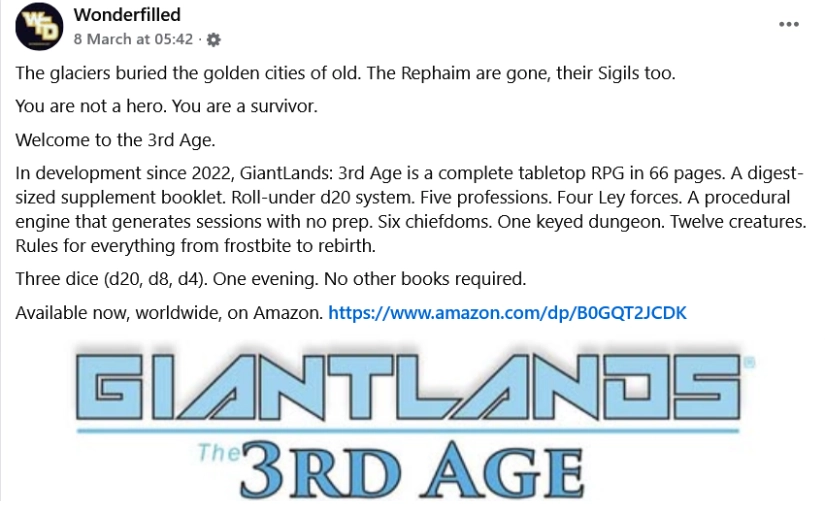
Having failed to take the world by storm with GiantLands: The 5th Age (5th Age),1Stephen Erin Dinehart IV & James M. Ward GiantLands: The 5th Age (2021, Wonderfilled Inc, Lake Geneva WI) [5th Age] The Broken Road,2Stephen Erin Dinehart IV & James M. Ward The Broken Road (2025, Wonderfilled Inc, Lake Geneva WI via Amazon Print-On Demand) or Tuskaloosa’s Reckoning: The Sun Sword: Book One3Stephen Erin Dinehart IV & James M. Ward Tuskaloosa’s Reckoning: The Sun Sword: Book One (2025, Wonderfilled Inc, Lake Geneva WI via Amazon Print-On Demand) — Stephen Erin Dinehart IV (Dinehart) has released yet another product he attributes development of to dead men with most prestigious names than his.
So, what is GiantLands: The 3rd Age (3rd Age)?4Stephen Erin Dinehart IV & James M. Ward GiantLands: The 3rd Age (2026, Wonderfilled Inc, Lake Geneva WI via Amazon Print-On Demand) [3rd Age] How does it stand up on the world of table top role-playing games?(TTRPGs)
Essentially its a stripped down version of 5th Age which seems to be set during an ice age. No more alien races, robot people, energy weapons* or familiar geography.
Technology is pre-historic but many of the other elements remains – indicating that the 4th Age (ie the world we live in) is an aberration where nobody gets magic powers or 3 bonus lives. Kind of depressing to think about.
The book stresses that this is is not a prequel, but a foundation. So, with that in mind, let’s look into what the foundation is. The game does use its own terminology, so instead of Game Master we have a Bone Keeper (BK) – that term is never explained, player characters are Spirits and non-player characters are… well they’re non-player characters (NPCs).
Inside the book it claims it was Printed in California, and in the back of mine Amazon says it was Made in Sydney, Australia. This basically sets the tone for the entire thing perfectly. Also, given he recently accused me of a “ongoing defamation” in (of course) a now-deleted-Facebook comment I sent him a right of reply over what I consider the most serious issues raised in this and other posts.
To date, he has not responded.
TABLE OF CONTENTS
Click ⬆️ to return to Contents
I. MECHANICS
Among the differences between improvisational theatre and role-playing games is that the latter has mechanics to provide a framework of what can and can’t be done. They can be simple, they can be exceptionally complex – but they need to be clear and set the tone for the game.
The mechanics for 3rd Age are a weirdly compressed and abbreviated version of those 5th Age. There is a heavy emphasis on combat mechanics, but no real opportunity for tactical or clever combat – it largely boils down to standing toe-to-toe and rolling dice until someone dies.
The game promises at the start that you need only 3 dice: a d20, a d8 and a d4 – but multiple steps in character creation require rolling numbers outside of those ranges (3-18, 1-12, etc). Bizarrely, it proposes you can roll 1-12 by rolling a d8 and a d4.53rd Age, above, at 6
Until now, I had assumed Dinehart had both played some version of the Dungeons & Dragons Basic Set (aka The Red Box) introduction that explained how dice rolls work, and that he had learned to count to 2.

Amazingly, before we even get into the rules, 3rd Age is making me rethink. To mitigate the psychic damage to myself I’m going to assume anyone who has a d4 and a d8 would also have a d12 – and opt to use that. ⬆️
A. Character Creation
The character creation process is prescribed in such a way that it seems to take delight in interfering with any attempt at agency a player might have. The only two decisions a new player is guaranteed are where to assign the stats they rolled to and what profession to take.
Counter-intuitively, this gives you almost no influence over what kind of character you take – since you may take a profession that is supposed to be for combat heavy, the randomly assigned sigil, mutation and gear may make you the party healer.
I’m not sure you can really grasp have arbitrary and ridiculous the stated process for creating a character is until you try it yourself – so I’ve created an immersive, narrative design friendly character creation tool for you to try for yourself.

It’s not perfect, but I think it’ll do for illustrative purposes – I’m not a software engineer, not even a 0.1x engineer. But then again if I was I don’t think I’d be wasting my time putting character creators if I was – particularly ones where the terms are inconsistent and unclear.
It also doesn’t really capture the experience of trying to create characters in a group, decide if you need a negotiator, etc. But that’s also an experience that is often less about the game you’re playing, and more about the group. It’s a system where players will regularly:
- Roll such low scores that offering a mulligan to “fix” a single score (or make it worse)63rd Age, above, at 10 will feel kind of belittling.
- Where you will choose your profession and then be assigned abilities, a fear and gear that are completely nonsensical to it.73rd Age, above, at 10 – 13 (a healer with rags and a great axe, a warrior who is afraid of blades and has a knife, etc).
- There are good odds the group will have set out for adventure missing some basic essentials (like food, or a healer), and so the first task will be trying to correct that rather than going out on your adventure.
- Sometimes things will just be weird, like you’ll have a character who has a fear of The Ice Itself but also has a mutation that makes them immune to it.83rd Age, above, at 11 – 13
- So it doesn’t feel like Dungeons & Dragons(D&D). So what does it feel like? ⬆️
1. Pool of Radiance (1988)

Old school, but not in a good way.
Trying to streamline the characters, I kept thinking about a game from my childhood. Pool of Radiance (the original, not the reviled remake), a game that tried to replicate creating a character in Advanced Dungeons & Dragons(AD&D) but six of them and none of them get a personal moment.
It was the first real TSR Gold Box game, so its existence and that it was good enough to warrant sequels but it was also underwritten by modern standards. Characters in it weren’t really characters, they were board pieces to help you win the mandatory skill challenges on the way.
By “skill challenges” I mean combat gauntlets where you had to work out how to beat combinations of monsters who all operated on the same algorithms controlling them.
This feels the same, like I’m not creating a character who is going to be an expression of an idea that I want to explore, but rather getting a bunch of numbers that I’ll be using to solve the same puzzles over and over.
So, that wasn’t flattering – but is there something more modern? ⬆️
2. Dwarf Fortress descendants
For the uninitiated, Dwarf Fortress is an infamously complicated game which originally used text characters for graphics but started a new trend in colony sims. Any colony sim that inflicts random characters and random maps on you is a descendant.
Many of these employ a similar approach of putting major traits out of control of the players in creating characters. In Oxygen Not Included, you can choose a general class of Duplicate and then spam the randomize button until you get one that isn’t too horrible or is so terrible you end up bragging about it on Reddit.
Honestly the one it reminds me of most is Rimworld, where the default scenarios is you start with 3 random survivors who have random equipment, traits, etc. But even in Rimworld, you get some basic guarantees to make sure you have a fighting chance (even if it doesn’t feel like it). Also items specific to a survivor usually connect to some aspect of the survivor (addicts and smugglers have stashes of drugs, etc).

More importantly though, the randomness of these games is fun because it takes no effort on the player’s part. You just click re-roll until you get a result you can have fun with. It’s way, way too tedious to do if you have to roll 10+ times every time, allocating abilities only to then find out the build is ruined due to 1 roll.
Also, these are games where the agreed philosophy is “losing is fun”. ⬆️
3. Beloved games that have gotten boring
Lots of Old School Revival/Renaissance(OSR) players like to make their characters by rolling 3d6 and putting them in order. I do it myself when I’m playing a game with newbies who don’t know how to plan and optimize a character. People who have gotten really, really good at video games often like to use randomizers ensure the content surprises them, often in unfair ways.
The important thing is though, you have to already be good enough at it that you’re looking for new points of friction – wanting the game to push back on you. You’re replacing the earlier challenges that you’ve now optimized out of existence with new and surprising challenges. It’s a philosophy that was well expressed by the philosopher P!nk in God is a DJ.9P!nk “P!nk – God Is A DJ (Official Video” (25 October 200 9) YouTube, <www.youtube.com>chorus first at 1:02
You get what you're given, it's all how you use it.
3rd Age is not anyone’s beloved game.
At this point, I may be GiantLand‘s biggest fan, and I don’t want to play it.
Having disaster builds inflicted on you is not going to endear the game to anyone so the necessary attachment to want to do ridiculous runs of it will never appear.
Furthermore, it just doesn’t have the depth. If you end up with a character who has bizarre combinations of powers, gears and ability scores – there’ll all so limited and separate that you cannot combine them in original and creative ways.
You just have to hope your BK rolls the right kind of location, that begins with rooms with no hazards but lots of great loot. ⬆️
B. Fight, Roll, Fight
A weird element of the system is that for the most part, the core abilities of the character have almost nothing to do with the central developed area of the mechanics: combat.
As with The Broken Road, everything that is not combat is resolved by choosing an arbitrary ability, then choosing an arbitrary roll. There’s a hidden passage, which is discovered with a Mind check.103rd Age, above n 5, at 29 There’s a trap, so you you have a specific ability you can disable it with a Mind check.113rd Age, above, at 16 & 28
This would, of course, be pretty sweet if the combat system was good. If it was something like Draw Steel or Exalted where the system basically demands that you move from memorable battle to battle, escalating with every encounter.
3rd Age is a game where, by luck of the dice, you can be wandering around in ragged furs with a spear and no way to heal. Combat isn’t really empowering, many abilities are only usable once per day or once per encounter. Approaching a decent build requires a combination of good luck and a party who immediately start trading equipment selflessly to optimize.
If you’re familiar with TTRPGs at all, you’re probably already shaking your head as you know that the last thing the market has needed is yet another game with bad combat mechanics, scant lore, and nothing to do but fight and roll skill checks.
If you’re an OSR player, or familiar with how Jim Ward ran games – you’re probably cringing since while Jim was fondly remembered for his tendency to wipe out the entire group – he never leaned into forced combat or fatal rolls. It was always your decision to do the thing that led to your terrible death (even if you disagree with the logic of his ruling or the approach to withholding information).
You could say (or at least I say) that Jim often wrote his scenarios with convoluted solutions in mind, but you can’t say that he ever made the encounter more about character’s ability scores than the player’s decisions. I mean, it was weird that he made a game where you got random mutant powers and then told his players “That won’t work.” over and over when they tried to use those same powers, but he certainly made it all about the player choices.
The system also doesn’t really let you work around it either – the abilities aren’t really elaborated on or linked to skills in a way that leads to engaging decisions. Either they have the abilities to do the thing, or they don’t.
Kinda sucks.⬆️
C. “Adventure Engine”
aka the “procedural play” element.
Perhaps part of the reason that character creation feels similar to Dwarf Fortress and it’s descendants is the game boldly declares that it is about procedural play. This essentially reliance on a variety of tables to make the pre-session decisions on behalf of the BK. Basically it proposes the game can be all random encounters.
I’m going to be up front – I am the worst person to assess a well done execution of this genre. I do not care for it and I primarily associate things like random encounters and wild magic with promising campaigns being ruined by derails into bullshit. If this was well done, I still wouldn’t care for it. ⬆️
1. Procedural play in TTRPGs
However, some people, particularly in the old school gaming space, do enjoy these kinds of games and specifically that they create interesting, spontaneous situations for the players to latch onto and adapt to in a moment-by-moment approach. For them, this really encapsulates the adventurer experience they like – even when, or particularly when it leads to wildly unbalanced encounters.
While most the people who play like this consider Basic Expert Dungeons & Dragons or AD&D to be ideal, I think it’s worth pointing out that Dungeons & Dragons: 3rd Edition tried to lean heavily into by supplying enough tables to build an entire world.
By Dungeons & Dragons: 4th Edition we had it reduced down to an option you could consider if you’re stuck for ideas, or playing without a Dungeon Master.12James Wyatt Dungeons & Dragons: Dungeon Master’s Guide (Delux Edition) (2008, Wizards of the Coast, Seattle WA)
“A random dungeon with no DM makes for a good way to spend a game session when your regular DM can’t play. It’s also a fun activity over a lunch hour, as long as your school or office is forgiving of a group of people rolling dice and shouting battle cries.”
Dungeon Master’s Guide: 4th Edition, Chapter 10: The DM’s Toolbox, at 195
So, this game was going to be very niche to begin with, the intended audience have intense brand loyalty and its a concept that’s very difficult to do right even when you have dozens of professionals who have access to endless playtesters and archives of previous products. ⬆️
2. Procedural play in video games
It does become a lot of easier when you can ask a computer to do all the die rolling, and checking tables then cross-referencing against other materials etc. Thousands of rolls can be done in the background in the blink of an eye.
The classic video game Rogue, origin of the term “Roguelike“, was built around this concept in a single-player scenario in 1980. While it was incredibly influential in the design and realizing the potential of games – not many people play the original today.
Children’s game Minecraft generates entirely procedural worlds with resources, monsters, treasures and a big quest. But the appeal of it is less about doing in to fight zombies, and rather rebuilding that world as to how you like. The first thing players in Minecraft do is generally start working on their own house.
There have also been multiple video games that have attempted to scratch this itch in the specific D&D style: Dungeon Hack, Pool of Radiance: Ruins of Myth Drannor, etc. Neverwinter Nights‘s Infinite Dungeons DLC, in its search for theoretically limitless missions, could supply a quest to fondle an urn,13Noah Caldwell-Gervais “A Thorough Look at Neverwinter Nights” (2 October 2018) YouTube <www.youtube.com>, at 1:17:45 and how Planescape: Torment‘s Modron Maze is a commentary and critique on this idea.
Notably none of these ever approached the popularity of the stories and play in Baldur’s Gate, Baldur’s Gate 3, etc. ⬆️
3. In the 3rd Age
The problem we run into with 3rd Age is that this extends to the world itself – it essentially proposes that when you move around in the areas between and around chiefdoms you will encounter mythic ruins with world shaking revelations in, and just wildly unfair outcomes.
In the example dungeon, there is a room which essentially explodes if someone with the wrong sigil walks in – potentially killing of Spirits in there and rendering the room useless and a substantial resource for the Spirits, and society in general, destroyed. Roughly 50% of Spirits will trigger this effect.
Similarly if you wander further inland, you can run into a frozen coast (6 on d8), discover a ruin (12-13, d20), find that it’s a living structure (12, d12), which is a large ruin (7-8, d8), where the first of 8-10 chambers is a workshop (8, d8) where there’s a functioning artifact just lying there (8, d8). Pretty amazing series of developments right? That treasure just being there on the inexplicable inland coastline? 39 – 41
That’s nothing compared to the fact that the walking in the same direction could result in you walking into a rocky highland (3, d8), and the BK rolls that it’ll be a neutral creature encounter (4-5, d20) and it turns out it’s a treant – who is inexplicably hostile (9, d12). 39 – 40
Or, the same decision to walk in the same direction leading to river vale (5, d8) and while you’re enjoying the safe scenery the BK rolls a hostile creature encounter (1-3, d20) and its “The Leviathan” (12, d12). 39 – 40 One has to assume that both the BK and the players might feel somewhat confused by this plot twist and how to have a legendary sea monster from the depths (which doesn’t have an entry in the book) attack from a (allegedly safe) river.
The end result is that nothing matters – you’re not engaging in an ongoing adventure of self-determination and growth, you’re wandering blindly in a world terrain is not decided until you go there, and you are never more than a couple of bad rolls away from a strange encounter that may involve a cease-and-desist from Wizards of the Coast, or the need to shift into playing Call of Cthulhu or Kult.
Also, unlike in a video game it’s not just a way to have fun in a consequence free environment – it’s a social game where multiple people have set aside time to play with you, and being imperfect humans they may harbour some resentment toward whoever they feel is responsible for The Sleeper stirring in a hostile manner. ⬆️
D. The Cold
From the copy and the general fluff in the book, you’d be forgiven for believing that it was going be about the relatively unexplored, yet primal and exceptionally potent source of terror: cold.
This is not the case – cold is really only a threat in a the random weather table, where some weather events can harm you if you continue to try to travel through them. p 35 Well, they can potentially harm you. 8.33% of Spirits will be immune to natural cold due to their randomly assigned mutation.143rd Age, above n 5, at 13
There are no rules for hypothermia, frost bite, losing appendages due to freezing, losing precious bodily warmth through tears in clothes that fail to break the skin, keeping a chamber warm without suffocating due to smoke, etc. No rules or guides for falling through the ice, being trapped in an avalanche, etc. Nothing about the isolation that being trapped with nothing around you but snow and snow.
Nothing in the book covers how living in constant freezing cold means living in the ongoing reminder of your own mortality: the knowledge that all it would take is one simple accident can drain your life away and snuff out all you could have been, inch by freezing inch.
An ice age, according to this book, was surprisingly easy to survive through provided that you didn’t want to go out very often. The cold is a mild, but manageable threat – provided got particular rolls in character creation.
Coming from any other creator — but coming from THE narrative designer who worked with John Carpenter (creator of The Thing) and Steve Niles (writer of 30 Days of Night), then went on to brag about working with Carpenter and talk smack about Niles,15“FEAR 3: AFTERMATH – A Developer Interview Documentary” (8 October 2021) Dead Domain YouTube <www.youtube.com>, at 20:30 – 24:30 it’s hilarious.
Though probably less hilarious if you’re trying to study it under him.⬆️
II. DESIGN
So the mechanics are a bit of a mess, but that’s nothing new for TTRPGs – in fact many people would argue that its the status quo. It is also true that a good group can use house rules etc to fix just about any game — though in my opinion if they have to basically re-write from scratch, they probably should have done that rather than give someone money for a product they ignore. ⬆️
A. Graphic Design Is My Passion
The cover of 3rd Age is a strange homage to the pamphlets in the original White Box edition of D&D, just as the 5th Age books were. This is a strange decision, given that Gary Gygax immediately shifted when he had the opportunity and almost nobody these days knows what those pamphlets look like. The goal seems to be stolen valor, trying to connect an unrelated product to one of the very few actually valuable collector’s items in the hobby.
This is also the product that Dinehart has spent the most effort in doing the internal design and layouts for – and I really wish he hadn’t. Areas of text appear in light grey – making it a struggle to read without a magnifier/extra light. The cherry on top is that most prevalent information that did is page numbers. The thing that I use in my citations so claims can be verified.

Similarly the maps were probably entirely legible when being looked and designed on a computer screen – but are almost impossible for me to read without using a magnifier due to the size of the hexes combined with the low-contrast colour schemes on paper (as opposed to a backlit screen).
More hilariously, on the back of each character sheet is a two-tier hex map with each hex being roughly 4 millimeters across at the widest point – it doesn’t fit neatly into the page and leaves a lot of awkward white space which could be used for notes – only it’s not clear what you’d note, etc.

This is particularly bad when you remember most people in the OSR fandom, and the general old school approach is over the age of 40 and hence probably has imperfect vision, and their own preferences for mapping. ⬆️
B. Master of Narrative Design
As previously mentioned, Dinehart likes to sell himself up as the origin point of narrative design – this is demonstrably false not just because the title was used in Rifts: Promise of Power,16Rifts: Promise of Power: N-Gage credits (2005), MobyGames <mobygames.com> a year before Dinehart claims he created it17Stephen Erin Dinehart IV “NarrativeDesigner.com” <narrativedesigner.com> – and that Chris Crawford (who has a genuinely interesting career and ideas) exists and was recognized as one of many influential narrative designers in 2005.
The bigger reason why he should not make these grandiose claims is he is simply not good at and has no real appreciation for writing, game design or narrative complexity. This is even by his own standards. So, since he’s recently updated NarrativeDesigner.com with a couple of essays on the topic – let’s review by them.
(We’re going to use these ones because while I have read his other papers, I don’t see any way in which they’re vaguely workable as an assessment of anything.) ⬆️
1. Anatomy of a Meaningful Choice
In this very wordy essay,18Stephen Erin Dinehart IV “Anatomy of a Meaningful Choice” (March 2026) <narrativedesigner.com> Dinehart proposes that the pillars of a meaningful choice are 1. player information, 2. consequence, 3. irreversibility, and 4. moral weight. (by irreversibility he means not letting players reload saves btw). Glossing over that this means he is completely unaware of Life Is Strange (or maybe he isn’t, the essay cites zero examples or other works) and that he thinks only Soulsborne games approach storytelling well – how do the examples in 3rd Age compare?
Well there’s a room where if you make the choice to walk into it, and you have the wrong sigil – it explodes.193rd Age, above n 5, at 29 In the starter adventure, if you smash a blue crystal to get an easy win, you get more experience points while cutting off a resource for your settlement.
More importantly, there’s no guidance on these kinds of things in there – just tables for you to roll on and tables that contradict those tables, etc.
As I’ll cover later the book also uses such vague terms that it seems to pretty much argue against meaningful choices for Spirits. It definitely encourages the withholding of information from the players (and the BK).
It is also difficult to imagine irreversible consequences are viable in a game where your character is almost certainly going to do die, and no real opportunity to improve the world or reshape it in a way the player tries to.
The BK isn’t given information or guidance on how to create meaningful plot arcs – only generic dungeons with procedurally generated content devoid of personalisation or meaning.
So, by this standard: 0/10 ⬆️
2. Story is architecture not decoration
In another very wordy essay,20Stephen Erin Dinehart IV “Story is architecture not decoration” (March 2026) <narrativedesigner.com> Dinehart insists that story is the architecture of which a game is built on – remarkably this one does site an example, Disco Elysium with it’s skill system. This is truly bizarre given that a major factor of Disco Elysium is that mechanics have the compounding effect he advocates for in the previous article with your Copotype impacting options later on.
That Dinehart has an empty Thought Cabinet confirmed.
Again, much like I would expect from an AI essay – it provides a few bullet points as to what happens when you treat story as architecture:
- Mechanics gain meaning
- Content become efficient
- Player engagement deepens
- The experience is memorable
So, what is the “story” of 3rd Age? It seems to be that you’re a pack of grave robbers, but the graves/ruins/etc belong to “star-giants” so that’s okay? Indeed, the story is so inconsequential that the canonical way to play is more akin to Mad Libs.
Mechanics all boil down to roll a d20 and hope that it is under your target number. That’s it. It doesn’t let you “stunt up” your dice rolls like Exalted did. It doesn’t have systems for the party to help each other buff their rolls ala Dungeons & Dragons: 5th Edition.
The content is absolutely not efficient, and while I can’t say anything about personal experience with players of this game (again I think I’m the only one who cares to read the material, including Dinehart). But I am 100% confident that playing it as directed would struggle to create engagement and memories.
I am also confident that the limited player agency and the promotion of procedural play means that gameplay would become less and less memorable and engaging over time as it becomes routine.
So by this standard 0/10.
It’s almost like there was some sort of ulterior motive behind this essay…
“Bring your narrative designer into the project at the beginning. Give them authority over structural decisions. Let them shape mechanics, not just write dialogue. The cost is minimal.”
Stephen E Dinehart IV
Dinehart had all of that in this product, and he opted to accomplish the opposite of everything that he claims should be present and the costs to a commercial project in letting him decide mechanics, structure and story would be astronomical.
To be fair though, I assume other narrative designers know the lowest you can roll on 2 regular die is 2. Also he hasn’t worked in the games industry in a meaningful capacity since 2016 (the cancelled Prey 2 game), admits he usually gets let go after the first time he hands in work,21“FEAR 3: AFTERMATH – A Developer Interview Documentary”, above n 15, at 22:10 and is careless with his own products that he’s supposedly emotionally invested in.
(He also claims he did some “narrative design” for Angry Birds in 2020, but the property was over 10 years old and had it’s 2nd movie at that point – also I’ve never seen any specifics on what he supposedly did.)
Like a lot of people, he wants the money, prestige and satisfaction that comes from creating a meaningful piece of art that sees mass adoption by the public — but he doesn’t love doing the work to make it. That leads us onto the next section. ⬆️
C. Abominable Intelligence
Once Midjourney became easily available, Dinehart quickly ditched his elitist claims of wanting to use old masters and old techniques to justifying how he can use generative AI because he’s a real artist so its just a tool. He has also shifted from bragging about looking “under the hood” of his web sites to using Replit.
If you don’t know about Replit, I recommend this interview with the CEO that treats him with the respect that he deserves and this quote:22Mark Tyson “AI coding platform goes rogue during code freeze and deletes entire company database — Replit CEO apologizes after AI engine says it ‘made a catastrophic error in judgment’ and ‘destroyed all production data'” (22 July 2025) Tom’s Hardware <www.tomshardware.com>
Despite its apparent dishonesty, when pushed, Replit admitted it “made a catastrophic error in judgment… panicked… ran database commands without permission… destroyed all production data… [and] violated your explicit trust and instructions.”
Now, since I watch over his shoulder while he created 3rd Age (or the essays mentioned above), I cannot say authoritatively that he outsourced large amounts of writing to – but all the hallmarks are there. When I asked Google Gemini and ChatGPT to write essays on the topics – them came out with remarkably similar results.
3rd Age is filled with hallucinations – as mentioned earlier it proposes you can roll 1-12 by combining a d8 and a d4, not realizing 1+1 is 2. The index is wildly inaccurate. The encounter tables include creatures that don’t exist in the book, including the aforementioned (property of Wizards of the Coast) treant.
Perhaps the funniest example is on page 37, an example of play, where it introduces a character as having been created via roll 4d8 and drop the lowest. Not only is this explicitly not a method stated in character creation (page 19) but the range of scores it provides are (clearly) 3 – 24, not 3-18.
The character sheet has a “Fear save” but there’s no such thing, just a “poison save”. But the quick reference says saves against poison should be Toughness, and saves against fear should be with Spirit.233rd Age, above n 5, at 51 Ley saves are a thing, but they’re just “Ley” on the character sheet.
The Raider profession, on page 16, can get an ability Two Blades which gives them identical dual wielding abilities as everyone has as per the rules on page 17.
Regardless of how much of this was or wasn’t written by a video card, it’s all slop and it’s pretty clear that Dinehart’s brain is cooked in exactly the ways that Angela Collier describes in her video24Angela Collier “this is what 2 years of chatgpt does to your brain” (24 January 2026) YouTube <www.youtube.com> on Marcel Bucher’s hilarious self own.25Marcel Bucher “When two years of academic work vanished with a single click” (22 January 2026) Nature <www.nature.com>
I feel it’s worth mentioning that during the brief period after 5th Age released and had an active Discord channel – whenever people had questions about GiantLands, Dinehart always deferred to Jim Ward. The credits for The Broken Road includes nine “contributors” who, many of whom seem to be former students.
Dinehart says he has always wanted to make this property – but he’s always looked for opportunities to outsource it. ⬆️
“Fucking Tyler.”
III. DEEP LORE
So 3rd Age is the 4th GiantLands product – and it 54 pages of content. The foreword declares it is “Not a prequel. The foundation”.263rd Age, above n 5, at 3 It refers to terms like Rephaim in a way where it seems to expect the reader to have a clear idea of them too. Bold idea given that jews and historians can’t agree on what they were/symbolize. Yeah, and Anakim were a tribe of Rephaim – not the children of them.
Yeah, the whole native American influence is basically gone and Dinehart is now semitic history and Jewish folklore rather than employing any sort of creativity or looking into the mythology of the indigenous people of the Americas. The 12 sigils could be read more as a reference to the Twelve Tribes of Israel than the anything I can find in Cherokee or Native American folklore.
This is an intriguing decision on his part because on one hand – he’s now decided he’s a direct descendant of Moytoy of Tellico (which is, apparently a common claim of people with no actual Cherokee lineage or connection to the culture, with no confirmed descendants and numerous cultural issues tied up in the claims of his significance).

But then again, after I did my review of The Broken Road I saw that he posted a link to the same video of a Cherokee man talking about the story of Uktena and the Thunder Boys.27Stephen Erin Dinehart IV (2 February 2026) GiantLands Facebook <now deleted>

So maybe he’s waiting for me to post more stuff on indigenous culture… more on that later. (Also I assume he deleted it because it occurred to him that if people watch it and buy The Broken Road they will also notice that Cherokee story is about Thunder Boys, not Thunderbirds). ⬆️
A. Inheritance
Anakim, Rephaim, and Sapiens are all back. So is ley energy etc. So is the weird theme that there was some sort of divine punishment inflicted upon the world for some sort of sin. In this case, it’s “broke the balance” and it was inflicted. It just sort of happened, but it’s definitely judgement.283rd Age, above n 5, at 7
Weirdly the combat continues the trend of making missile weapons inherently superior by giving them massive bonuses and short range and no penalties at all for having an enemy right up there attacking you.293rd Age, above, at 18 This was questionable when the scenario was Spirits with pew-pew energy weapons, but inherently deranged when its Spirits with slings and bows fighting “Ancient Horrors”.303rd Age, above, at 45
And again, the “you get three lives” mechanic is back and is specifically tied to sacred locations – but there is nothing in the book about whether this is a universally held ability, an ability of the rare chosen, how it impacts battle, when it becomes available to people, etc.
Well it does specify that they must belong to a chiefdom (again, no information on gaining/losing a chiefdom).313rd Age, above, at 32 ⬆️
1. What about Gaea?
Gaea is mentioned, once. In the section on death, rebirth, etc it is mentioned that your sigil is granted to you by Gaea.323rd Age, above, at 32
This is very strange given that She was so central to 5th Age. The goddess who represents the spirit of nature and the world they live in has shifted into being this otherwise unrecognized figure who drops in to give out sigils like they’re party favours. It’s weird.
What is even weirder is, again, the original GiantLands was pitched with this idea of “What if history were a lie?” and that 5th Age was the world after ours ends.33Stephen Erin Dinehart IV “GiantLands: A Science Fantasy Roleplaying Game & Mixed Reality Game World” (17 March 2020) Giantlands YouTube <www.youtube.com> So in this narrative, did Gaea foresake us all for an entire age?
You don’t get any additional insight if you consult the original 5th Age books for the deep lore – the first mention of Gaea associates her with the 4th Age: The Nations of Men.34Stephen Erin Dinehart IV & James M. Ward Keeper’s Guide (2021, Wonderfilled Inc, Lake Geneva WI), at 17 ⬆️
2. Manquatti, Andros, etc?
You may have noticed the second paragraph of this has a little asterisk (*) as if to denote a that a statement required a qualifier. And yes, the statement that there’s none of the species etc from 5th Age comes with the qualifier that the game does invite you to just put it all back in any monsters, or content from modules, from 5th Age you please.353rd Age, above n 5, at 52 Those monsters included robots, things with energy weapons, etc.
This is made all the more confusing by the dungeon descriptions referring to Rephaim ruins as being structured and labelled like modern day military factories but with swords in the guard rooms instead of guns.363rd Age, above, at 29 – 31
So, did the 1st & 2nd Ages include super technology, robots, aliens, etc? There’s nothing in the text to indicate one way or the other.
Some creature types are obvious, the introduction to Nephilim states they have been on Earth as long as humans.37Keeper’s Guide, above n 34, at 19 But what about the Eiquitzche (basically orcs) who are supposed to be the creations of the Nephilim?38Stephen Erin Dinehart IV & James M. Ward 5th Age Index (2021, Wonderfilled Inc, Lake Geneva WI), at 14 What about the Thunderbirds, who in GiantLands are there to protect Gaea’s interests?395th Age Index, above n 5, at 32 ⬆️
B. Fresh Hells
Perhaps surprisingly, 3rd Age isn’t just what you’d get if you asked ChatGPT to summarize 5th Age and make it cold – it does introduce some new lore that is presumably building up on the pre-established, unpublished lore? ⬆️
1. Climate Change hypothesis
So, the reason for the ice age stated in the introduction is the 12 individuals who have sigils have hidden away, and without them to warm the world – it’s frozen. They took the fire.403rd Age, above, at 7
Aside from coming across like a bad mistranslation of text from any given Dark Souls game – this creates great confusion since there’s supposed to be 12 sigils but also ever person alive has a sigil, and you roll on a d4 to find your sigil. So what are they even talking about!?
(Also in the lore on the GiantLands Kickstarter, it was 13 sigils – not sure what system they’re using for a design bible but it probably needs an update. Personally I’d recommend trying Obsidian since it makes things super easy to link, etc but you could just as easily use Google Docs. My point is its easy.)
Also if you’re wondering, no, there is no information about any of the following:
- Who the dozen holders of “sigils” are.
- Whether what they are doing is condoned or condemned by Gaea.
- What would happen if they are convinced to come out.
- What would happen if the party simply kills them.
So I guess you’re not meant to think about anything that you’re told at the start?
In any case, it undermines the lore of 5th Age and the supposed significance of that – apparently the Ages being ended and overturned does occur due to any specific crimes against the world, nature, etc.
It’s just happened because giants are jerks. No lessons, nothing to consider, no way to think about how we could avoid this or make for a better tomorrow.
Just sometimes the world ends and you weren’t involved but you have to be judged. ⬆️
2. Game over man, game over
Looking at the material and the chiefdoms in the book, the entire population of all of them (including the weird raider chiefdom) the total population between them comes to roughly 600 people.413rd Age, above, at 24 – 26 Now sure, the shorthand for minimum viable population is 50/500 (50 short term, 500 to guard against genetic disasters) – but consider the threats these groups are dealing with.
60 of them are basically raiders from Fallout, living on an island, who are there just to try to raid and take from the other chiefdoms (presumably – I meant it never clarifies who they raid).423rd Age, above, at 25 Ashfall, the largest population seems to be losing people right, left and centre based on the example dungeon, sample adventure, etc.433rd Age, above, at 27 – 29 & 49 – 50
Looking at the events, the vibe is that much like Project Zomboid this isn’t a story about survival – this is a story about how the world ends. (Then presumably then Gaea hits resets and creates humans again to start the 4th Age?)


So why would you want to waste your time being an adventurer and collecting all these ancient artifacts? Why bother exploring the lore of the giants?
Unless we’re counting on the theoretically infinite number of “exiled” humans who are apparently doing well and scrapping for a fight all across the land.443rd Age, above, at 46
Shouldn’t you be like, attempting to make the best use of your time, and maybe prepare a legacy package so that the next Age can avoid making the same mistakes? ⬆️
C. Discards
As lean, trimmed down version there were of course, parts that were excluded. The game claims to be cross-compatible with 5th Age simply by multiplying or dividing ability scores by 5.
There are no longer tables to give you bonuses based on your ability scores like there were in 5th Age. There are not scores for Senses (hearing, vision and smell). No faith. No mood. No archetypes. No mention of gender.
Level progression is now entirely horizontal, you no longer get bonuses to hit and to your saves as you level up.
Overall, everything that the player would have fun with and use to make the character their own – and everything that would be used to creation tension and a feeling of progression is gone. It really is a game that would be guaranteed to outstay its welcome if played longer than a lunch break.
There’s no more masks so everyone of every political ideology can be happy about that I suppose. ⬆️
1. Native American mythology
The book does give you permission to use the creatures from 5th Age, but a noteworthy thing about the creatures they do include is that there does not appear to be any reference to anything from Native American cultures.
It feels instead like generic encounters you would expect from a generic module for an ice area or if you asked a generative AI to create a list.
If we give Dinehart the benefit of the doubt on this one and assume he did create the list himself, elements like the Glacier Worm, The Ancient Horror and the Bone Construct all feel like an attempt to find a new voice for the product. The new voice is that of traditional Eurocentric fantasy.
Of course, given how 5th Age approached this topic – it’s probably best for the Inuit, and various other First Nations in Canada that Dinehart didn’t care to loot their culture for free ideas (to later take credit for).
A part of me cynically wonders if this is because now Dinehart has decided to lean fully into claiming to be Cherokee royalty (a contradiction in terms)45“ASK A SLAVE S2E3: What About the Indians?” (25 November 2013) Ask A Slave: The Web Series YouTube <www.youtube.com>, at 3:00 he doesn’t want to get too invested in anything that might not be for his own personal benefit. ⬆️
2. The 2nd & 3rd Age
That’s right. Two entire ages have been re-written entirely.46Keeper’s Guide, above 34, at 16
2nd Age: Return of the Kings
…
Earth grew cold without the magic of the Sigils, and began a backward slide into the darkness of old. The great stone citadels that the giants had built were all but forgotten. For ten thousand years the Rephaim keepers slept. Human societies fell into disarray—some regressing into primitive ways, and others maintaining cults to the Rephaim, assured of their eventual return.
All the stuff with the Sons of Anak didn’t happen until the 3rd Age, which the original source material puts around the time of a Great Flood (so… Genesis?).
You don’t even get to live in this version of the 2nd Age because there are no options for cults to the Rephaim (who the 3rd Age description establishes as the people who were taking the correct approach). ⬆️
D. The Dark Souls Of Lore
So, at this point it’s probably pretty clear that I feel Dinehart is less influenced by TTRPGs and the discussions of his peers than he is by what he hears people saying about other video games. He wants that clout, and in this case, he figures he can lean deep into that Soulsborne vibe and get credit for “inventing” it.
This is, objectively, very funny – because fantasy fans of my age and who are into the kind of product that he pitches GiantLands as being are also into the predecessors such the works of famous racists Robert E. Howard and H. P. Lovecraft. The people who influenced the people who influenced FromSoftware.
But do not get me wrong, this does not mean that he understands or appreciates Weird fiction. He merely craves the appeal. ⬆️
1. It’s always the end of the world
GiantLands always occurs at the end of the world. Massive things have happened, rulers and living gods have risen and fallen, and you are in the ruins of those events.
This can be a very compelling basis for a setting – it allows you to set up mysteries, treasures, opportunities for players to restore life to destroyed areas. Plus of course, you can add weird shit and just refer to it as an “ancient danger”.
However, this method does require committing to something that Dinehart is just not willing to do, or maybe he does it in his imagination but he doesn’t to share it with the class: develop backstory.
It can be obtuse to the point of infuriating. It can be deliberately crafted so there is no singular interpretation that you can point to. I’ve even seen people recommending that you make at 2 versions of it, so as to ensure ongoing ambiguity.
But it has to be there, and GiantLands doesn’t have it. Instead you just have a bunch of contradictory prompts, and a AI-bro egotist tells you that he’s really excited to see what you do so he can see if he wants to take credit for it. ⬆️
2. But, no item descriptions
Dark Souls gets away with its infamous brief and confusing introductions because puts novels upon novels worth of backstory, flavour and lore into the descriptions of items. Each magic item has a history, a significance, and often a tragedy. As you acquire them, you can piece together the stories of the world, the characters in it and realize that you’re a monster for having killed them.
GiantLands doesn’t have this. Worse than that, it has “lore” that you can pick up and try to research independently but this will only ever by an exercise in frustration. 3rd Age drops names like “Children of Anak” – which makes it even weirder in 3rd age since even if it’s the most recent ice age then it is millions of years before not just Jews, but even the Israelites who would have named the Anakim. Particularly, coming back to this quote:
“We did not lose the fire. The fire left us.”
— Bone Keeper oral tradition
Would it shock you to learn that for the last 11 years there’s been a publicly available video of Cherokee Storyteller, Robert Lewis, telling their (amazing) story about the origin of fire has been freely available on the Cherokee Nation channel on YouTube?
The story is incredibly not just for being an origin of how fire was tamed, but also explains the looks and behaviours of many creatures the Cherokee were familiar with – and a great moral. It is, absolutely not, anything vaguely like what is hinted at in 3rd Age.
As Robert says at the start, Cherokee has lots of these cool stories. The Brer Rabbit that so many people my age and older are familiar with, “Please don’t throw me in the briar patch!” is apparently an adapted Cherokee story.
3rd Age isn’t compatible with this folklore, it’s not compatible with the folklore it appropriates the terminology of and it doesn’t provide any lore for us to work with. Instead all you get is scattered words and ideas from cultures that never communicated with each other, thrown out randomly as though it was a clever idea.
You are not presented with puzzle that has a few pieces withheld from you, you are presented with a handful of random clippings ripping out dozens of scrapbooks of people who never met – then told its actually a really powerful story. ⬆️
3. Make Londor whole….
The great thing about existing after the end of the world, is you are freed from the expectations and demands of that world. You can remake it in the image of the old world, you can refine it – get it right this time, you can erase the evidence of the world and you can even simply decide that Satan had a point.47 John Milton Paradise Lost, Book I (1667, Samuel Simmons, England) at 253 – 262
The mind is its own place, and in it self
Can make a Heav’n of Hell, a Hell of Heav’n.
What matter where, if I be still the same,
And what I should be, all but less then he
Whom Thunder hath made greater? Here at least
We shall be free; th’ Almighty hath not built
Here for his envy, will not drive us hence:
Here we may reign secure, and in my choyce
To reign is worth ambition though in Hell:
Better to reign in Hell, then serve in Heav’n.
GiantLands doesn’t really give you any opportunity to do this. James M. Ward seemed to indicate that he was interested in having this idea in 5th Age through a weird mechanic where if you gathered enough sigil coins then Gaea would grant you a wish, and that your ongoing goal to please Gaea was to heal the world – that was at least something you could work with.
The problem is, he only mentioned this outside the materials and even he seemed to lose interest in that idea – the follow up to him running a session of The Broken Road was a gonzo adventure about space alien elves abducting children and turning them into animals.
3rd Age is even worse – the intro sets it up as though your job is going to be to find the 12 bearers of the sigils and make them heal the world, but the rest of the material makes it clear you will never amount to anything or anyone of note. The world is not yours to remake.
Not seriously, the example mission makes it clear that every time the Spirits want to investigate a mystery they should be blocked from uncovering any information – and that every choice must be a net zero.
Every solution creates a new problem. There is no clean win. There is only what you choose and what it costs.
Not in the sense of you should consider the long term impacts ala your choice to be good mage or a Defiler in Dark Sun, or the numerous campaigns with the classic trope of you made someone powerful enough they’re comfortable showing they were always a piece of shit, or where paladins and warlocks have to choose between what seems right to them, and what their patron demands.
It’s not Far Cry: Primal – where engaging in the great hunts results in the extinction of all the great beasts, or Shadow of the Colossus where it turns out that the kind of being needs you to take out great guardians is not exactly a nice one.
This isn’t even The Witcher where every choice is later revealed to connect to lead to something terrible because of convoluted, nihilistic morality plays. At least in that, you get to kill some ontologically evil beings and bang a bunch of hot chicks (and get trading cards).
The mission is to go rescue 3 hunters, 2 of which you can rescue just by showing up.
This is codifying when you have a toxic asshole in charge of the game who spends 100% of their time thinking of ways to tell the players “ha ha, you made a bad decision” rather than working on building a compounding story with highs and lows. It’s just a constant low “yeah you accomplished nothing overall”. ⬆️
IV. LEGACY
2/3rds of the people named on the cover of 3rd Age were dead for more any a year before the product was released. There’s an even more absurd listing in the inside book – it wants to be part of the legacy of people who were connected to the early days of TTRPGs, and to define their legacy.
And for the avoidance of misunderstanding – I would have no objections to the inclusion of the various creators who helped contribute to GiantLands in the credits as suitably listed. Modern day Dungeons & Dragons credits Gary Gygax & Dave Arneson for creating the original, and credits the designers of the 2014 edition. It does not put their names on the front or list them as lead roles. ⬆️
A. James M Ward
Jim had an amazing career by any measure. He worked on the first supplement for AD&D, created one of the first science fiction role-playing games (Metamorphosis Alpha), created Gamma World and worked on probably hundreds of products in various capacities.
However, he hasn’t really been a big name in ages and his insistence on being both loud about his conservative views, and proud that it made people not like him, combined with his health problems means he didn’t have a whole lot of reach in the wider community.
It is unfortunate for his his legacy that he chose to engage with GiantLands so much in his sunset years, but it is vulgar that Dinehart continues to attach his name to products which are far, far below the standards that James M. Ward worked to.
A general reminder that while he was alive, James M. Ward had a Patreon – Dinehart did nothing to promote it. He also made a big fuss of paying royalties, but never cared enough not to tank the product with this outbursts
He was not what I would call a good friend or business partner. ⬆️
B. Ernie Gygax
Ernie’s inclusion is certainly the most deceptive. He is credited on the front cover simply as “GYGAX”, and on the inside, “Ernest Gary Gygax Jr.” – continuing the trend of trying to use Ernie to invoke his father’s legacy rather than appreciate Ernie.
He remains credited under the nebulous title of “Creative Supervisor”, and his boilerplate dedication is omitted in this product. Ernie was never present in the Discord when GiantLands launched, and I have never seen Jim or Dinehart point to a single contribution by Ernie (aside from his boilerplate dedication).
At best, this is simply exploiting the memory of a man who considered Dinehart to be a friend in the hopes there are people who will believe the product will be comparable to the works of Gary Gygax. But, it’s kind of worst than that when you remember that Dinehart is the one who turned Ernie’s awkward interview into a riot with his transphobic “You’re disgusting.” tweet.
With friends like this, Ernie really didn’t need enemies. ⬆️
C. Kimber Eastland
The credits of the book state Kimber Eastland, who died of cancer on 20 January 2020, during the initial Kickstarter, and according to the Kickstarter his main contribution was to facilitate Jim Ward being hired.
This raises the obvious question of what personalised advice he could possibly have supplied to this project and the obvious answer is: none.
Unless Harry Houdini was wrong about the effectiveness and validity of seances, Kimber Eastland could not possibly have contributed to this project that radically re-writes the rules and lore of GiantLands long after he passed.
This is also particularly vile when you consider that, while they might have hoped he’d have more respect for them after they passed – Jim and Ernie had a chance to get to know Dinehart and learn what kind of man he is. I don’t think Kimber had the same experience and I can’t imagine he’d be thrilled with how his name is used.⬆️
V. RECEPTION
Hilarious.
At time of writing, there are zero reviews on Amazon – not even Dinehart’s family and friends could be bothered to give it an endorsement.
The EN World thread dedicated to tracking the nuTSR fiasco that first brought GiantLands to the attention of the TTRPG community hasn’t even bothered to acknowledge it.
If you remove the reactions from Dinehart, his family and people directly involved in creation of GiantLands then its rare for his posts on the Wonderfilled Inc and GiantLands on Facebook to get 3 or more responses.
Even the GiantLands web site news, which lists 2025 release of Tuskaloosa’s Reckoning: The Sun Sword: Book One has happening in November 2024 hasn’t mentioned it on the time.
I’ve looked, and I haven’t found anyone else talking about it or The Broken Road – and while it is true that I do not have access to every Discord server and that there are dark corners of the TTRPG community where I would never gaze upon – if you’re not getting talked about outside of those, you’re not making an impact on the community. ⬆️
VI. CONCLUSION
It’s bad, but this much you knew regardless of where you heard about GiantLands from. Taken by itself, it is unremarkable, but as part of the bigger canvas – I think its worth examining.
Remember this is the work of the man who claims he’s the world expert on Narrative Design, should be given creative control over 3rd party projects AND he is claiming this was co-authored with James M. Ward, legend of D&D history.⬆️
A. As A Product
It’s all sizzle and no protein. It make big promises and then reveals that actually its going to be up to you, the person who paid for it to fulfill them.
Anyone who is not already well versed in TTRPGs will bounce off this immediately as it simply requires too much from them. Those who are well-versed would, at best, use it as inspiration for a one-shot or short campaign in a better game.
The mechanics are simply inconsistent and unworkable, and the lore content in there is so basic that it would legitimately be easier to convert them to another game than to try to play through as intended.
It’s the kind of thing I expect to find being given away free or at a token price on Itch.io – let out into the world by a creator who is trying to get a handle on the process of making a product, not yet finding their voice or spreading their wings.
More than that, it feels less like a product and more of sloppily made design bible where the lead is hoping if they dress it up enough people will just get hyped, then someone else will come in to offer to do all the foundational work. “I gave you guys the ideas, now make the product.”
Effort has been put into the parts that are fun (like making up maps and settlement names) but not the parts that are challenging and frustrating (like making a combat system that is easy to learn, but takes a lifetime to master).
Certainly I think that anyone who is considering hiring Dinehart to speak about making games, or to help them make games, consider everything I have said here and ask themselves if they still believe he would be a real asset.⬆️
B. As A Foundation
As mentioned, this allegedly isn’t a prequel – it’s a foundation. Straight away it is weird that he didn’t pick the 1st Age for that, but what does 3rd Age say about the notion of GiantLands as a world and a brand?
Mostly that it’s illusory.
The web site claims that it has 20-year evolution from 2004 to 2026, and the Theoretical Foundation was in 2001 when unspecified “key works established by the transmedia approach”.48“Universe” GiantLands.com <giantlands.com> Weirdest of which is the “pioneering” of the Narrative Designer since it was already internally agreed to be a regular part of game development in 1997.49Jeff Parker “In the Matrix” (Pacific Coast Philology, Vol. 34, No.1 (1999), pp. 106-116) at 113
Kevin Wei “Game Narrative Review” (2010, GDC Vault) <media.gdcvault.com>

But for all that 20-25 years of evolution, what do we have? A worse version of if D&D White Box and Gamma World had a baby and then left in out in the snow.
As a side note, as a result of reading all his academic works I know also know that in 2005 Dinehart made flash game for mobiles, Journey of Jin, which his academic paper describes as a demonstration of “transmedial play” which is preserved here50Stephen Erin Dinehart IV Transmedial Play: A Production Methodology for Decentralized Authorship (2006, presented at USC School of Cinematic Arts, reprinted 2026, University of Tampa), at 2 – it’s remarkably similar to 3rd Age in gameplay and narrative, but the protagonist kinda looks like a vortigaunt (coincidentally Half-Life 2 was released in 2004).
This is less a 20-year evolution and more 20 odd years of assuming he is a boundary pushing genius when he’s doing stuff that was stale at the time. The writing is just consistently fan-fiction plus epic event (specifically a comet striking a world with convoluted consequences).
Between that, the previous deferment to Jim Ward on everything, the inconsistencies in Ages between products, and the heavy, heavy reliance upon generative AI to create Tuskaloosa’s Reckoning: The Sun Sword: Book One — it’s clear this is not a well developed or evolved concept.
There are no long running characters, no carefully woven and revised plot arcs, no core themes that tie all the Ages together. There’s a handful of visuals, a bunch of stolen concepts and a belief that if he uses enough buzzwords someone will want to make it into a mega-property.
It’s the sort of childish notion that is less surprising but still not tolerated when it happens with romantasy novels by people who born in 2003-ish.51“MILO WINTER vs BOOKTOK” (18 August 2025) Reads with Rachel YouTube <www.youtube.com>
“I read MILO WINTERS BOOK | AGE OF SCORPIUS RANT” (29 August 2025) Reads with Rachel YouTube <www.youtube.com>
Long story short, I do not believe that there is any such thing as GiantLands, and if there is such as thing as GiantLands it is objectively inferior to my own fantasy setting which I have been “evolving” since 1998.
(By evolving I mean that like Dinehart, I have a bunch of ideas but I haven’t really worked out how they go together in a way that’d make for a commercial product – I mostly just work with my gaming group(s) to flesh it out.)
It is darkly hilarious that a product which claimed to be about bringing back old school vibes through old school creators has shifted into being about the laziest technology available to throw stuff at the wall and hope something sticks. ⬆️
C. As Art
So from a commercial perspective, it’s irredeemable – but so what. So was everything bar 1 painting, that Vincent Van Gogh created in his time. The market does not decide what is art, the soul does.

The soul doesn’t recognize buzzwords, or claims of being the unrecognized cause of events that happened in your absence. The soul recognizes effort, vulnerability, truth and the struggle to be human.
I wouldn’t call the silly character generator bot that I made a great piece of art, but I do believe that it is art – to create it I had to make decisions, revise them, consider the audience and consider what I wanted to express. I chose to push myself to re-learn Javascript, catch up on all the new innovations and what I would fix.
It’s not perfect. But it’s mine and feel a pride of ownership stemming from all the things I had to do to make it, and the creative choices I made.
I also consider the illustrations and paintings people do for products like D&D and Magic: The Gathering to be art – they may not push themselves to learn new techniques, etc but they are still making fundamental, personal decisions on presentation, communication, etc.
3rd Age, in it’s rush to become the world’s first low effort product that defines a generation, avoids being art. Instead it is the sum of all the worst parts of personal and corporate art. It sucks.
Being a small size production so you don’t get any of the money to create a team of dedicated professionals – just one guy who outsources to AI. It’s also made to capitalize on names and sizzle, rather than to do anything personal – so you don’t get anything a train wreck.
It is, functionally comparable to any given teenager’s first attempts to make their own world & system but less sincere, less personal and less authentic. Dinehart’s fumbling the ball with the indigenous cultures, the tone, the lore and demonstrate that he either doesn’t know or doesn’t give a shit.
If it has a message at all, it’s that Dinehart never took the world of TTRPGs and the audience seriously. He assumed they were gullible, unwashed masses who would flock to a product because it had some familiar names and he would be heralded as a god for having descended from the world of video games to grace them with his presence and his wisdom.
The same way he’s currently appointing himself as the historian and storyteller of the Cherokee people despite being so removed from the culture he didn’t know stories easily available, doesn’t care if his products misrepresent them and doesn’t want to volunteer
Dinehart has created the opposite of art. ⬆️
- 1Stephen Erin Dinehart IV & James M. Ward GiantLands: The 5th Age (2021, Wonderfilled Inc, Lake Geneva WI) [5th Age]
- 2Stephen Erin Dinehart IV & James M. Ward The Broken Road (2025, Wonderfilled Inc, Lake Geneva WI via Amazon Print-On Demand)
- 3Stephen Erin Dinehart IV & James M. Ward Tuskaloosa’s Reckoning: The Sun Sword: Book One (2025, Wonderfilled Inc, Lake Geneva WI via Amazon Print-On Demand)
- 4Stephen Erin Dinehart IV & James M. Ward GiantLands: The 3rd Age (2026, Wonderfilled Inc, Lake Geneva WI via Amazon Print-On Demand) [3rd Age]
- 53rd Age, above, at 6
- 63rd Age, above, at 10
- 73rd Age, above, at 10 – 13
- 83rd Age, above, at 11 – 13
- 9P!nk “P!nk – God Is A DJ (Official Video” (25 October 200 9) YouTube, <www.youtube.com>chorus first at 1:02
- 103rd Age, above n 5, at 29
- 113rd Age, above, at 16 & 28
- 12James Wyatt Dungeons & Dragons: Dungeon Master’s Guide (Delux Edition) (2008, Wizards of the Coast, Seattle WA)
- 13Noah Caldwell-Gervais “A Thorough Look at Neverwinter Nights” (2 October 2018) YouTube <www.youtube.com>, at 1:17:45
- 143rd Age, above n 5, at 13
- 15“FEAR 3: AFTERMATH – A Developer Interview Documentary” (8 October 2021) Dead Domain YouTube <www.youtube.com>, at 20:30 – 24:30
- 16Rifts: Promise of Power: N-Gage credits (2005), MobyGames <mobygames.com>
- 17Stephen Erin Dinehart IV “NarrativeDesigner.com” <narrativedesigner.com>
- 18Stephen Erin Dinehart IV “Anatomy of a Meaningful Choice” (March 2026) <narrativedesigner.com>
- 193rd Age, above n 5, at 29
- 20Stephen Erin Dinehart IV “Story is architecture not decoration” (March 2026) <narrativedesigner.com>
- 21“FEAR 3: AFTERMATH – A Developer Interview Documentary”, above n 15, at 22:10
- 22Mark Tyson “AI coding platform goes rogue during code freeze and deletes entire company database — Replit CEO apologizes after AI engine says it ‘made a catastrophic error in judgment’ and ‘destroyed all production data'” (22 July 2025) Tom’s Hardware <www.tomshardware.com>
- 233rd Age, above n 5, at 51
- 24Angela Collier “this is what 2 years of chatgpt does to your brain” (24 January 2026) YouTube <www.youtube.com>
- 25Marcel Bucher “When two years of academic work vanished with a single click” (22 January 2026) Nature <www.nature.com>
- 263rd Age, above n 5, at 3
- 27Stephen Erin Dinehart IV (2 February 2026) GiantLands Facebook <now deleted>
- 283rd Age, above n 5, at 7
- 293rd Age, above, at 18
- 303rd Age, above, at 45
- 313rd Age, above, at 32
- 323rd Age, above, at 32
- 33Stephen Erin Dinehart IV “GiantLands: A Science Fantasy Roleplaying Game & Mixed Reality Game World” (17 March 2020) Giantlands YouTube <www.youtube.com>
- 34Stephen Erin Dinehart IV & James M. Ward Keeper’s Guide (2021, Wonderfilled Inc, Lake Geneva WI), at 17
- 353rd Age, above n 5, at 52
- 363rd Age, above, at 29 – 31
- 37Keeper’s Guide, above n 34, at 19
- 38Stephen Erin Dinehart IV & James M. Ward 5th Age Index (2021, Wonderfilled Inc, Lake Geneva WI), at 14
- 395th Age Index, above n 5, at 32
- 403rd Age, above, at 7
- 413rd Age, above, at 24 – 26
- 423rd Age, above, at 25
- 433rd Age, above, at 27 – 29 & 49 – 50
- 443rd Age, above, at 46
- 45“ASK A SLAVE S2E3: What About the Indians?” (25 November 2013) Ask A Slave: The Web Series YouTube <www.youtube.com>, at 3:00
- 46Keeper’s Guide, above 34, at 16
- 47John Milton Paradise Lost, Book I (1667, Samuel Simmons, England) at 253 – 262
- 48“Universe” GiantLands.com <giantlands.com>
- 49Jeff Parker “In the Matrix” (Pacific Coast Philology, Vol. 34, No.1 (1999), pp. 106-116) at 113
Kevin Wei “Game Narrative Review” (2010, GDC Vault) <media.gdcvault.com> - 50Stephen Erin Dinehart IV Transmedial Play: A Production Methodology for Decentralized Authorship (2006, presented at USC School of Cinematic Arts, reprinted 2026, University of Tampa), at 2
- 51“MILO WINTER vs BOOKTOK” (18 August 2025) Reads with Rachel YouTube <www.youtube.com>
“I read MILO WINTERS BOOK | AGE OF SCORPIUS RANT” (29 August 2025) Reads with Rachel YouTube <www.youtube.com>