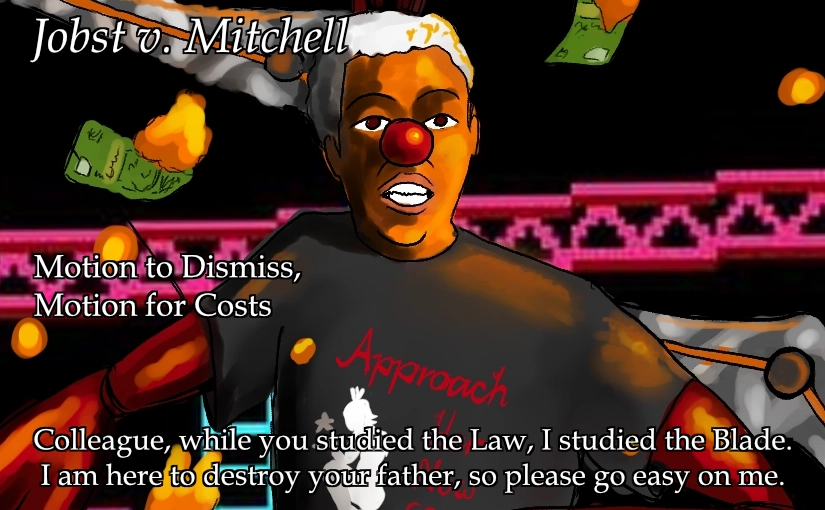
Okay, so it seems this lawsuit1Jobst v. Mitchell, 0:26-cv-60997, (S.D. Fla) [Karl v. Billy] has been a relatively popular topic and while it is also being covered by some others – I don’t care for the commentary (or in the case of at least one former Florida lawyer – the commentator) and they don’t seem to be doing any informed, deep readings.
The subsequent events are probably best summarized as follows:
- Billy Mitchell(Billy) has hired the law firm his own daughter(Michele) works at, and she was originally appointed as the 2nd attorney on his case.2Karl v. Billy, above n 1, (May 19, 2026) ECF No 9 & (May 20, 2026) ECF No 10
- The court has concluded that since Karl Jobst(Karl) is a Non-Prisoner Pro Se Plaintiff, it will be heard by a Magistrate Judge (basically a junior judge), which in the District Court is still generally a well seasoned judge who just hasn’t been appointed to the main job.3Karl v. Billy, above n 1, (May 26, 2026) ECF No 11
- A motion to dismiss has been filed by Michele on Billy’s behalf.4Karl v. Billy, above n 1, (Jun 9, 2026) ECF No 16 [Motion to Dismiss]
- Michele, who apparently just got licensed for the Federal court this year, has gone full “Let Me Solo Him!” and taken over as the lead and singular attorney.5Karl v. Billy, above n 1, (Jun 9, 2026) ECF No 15 & (Jun 12, 2026) ECF No 19
- Billy has filed for security as to costs since Karl is suing him from overseas, while bankrupt, and owing Billy a fortune.6Karl v. Billy, above n 1, (Jun 10, 2026) ECF No 17 [Motion for Bill of Costs]
- Karl has filed his response to the Motion to Dismiss.7Karl v. Billy, above n 1, (Jun 12, 2026) ECF No 18 [Response in Opposition]
- Karl has also filed a response to the Motion for Bill of Costs, complete with an exhibit.8Karl v. Billy, above n 1, (Jun 19, 2026) ECF No 20 [Response in Opposition (Costs)]
It’s great drama, but just to make it clear – I want both sides to lose (somehow). But I thought it’d be good to do a point-by-point breakdown of the submissions.
DISCLAIMER
While I have a law degree (New Zealand) I am not currently a lawyer, more importantly I am not your lawyer so nothing in this is to be understood to be personal legal advice. It is provided for educational and entertainment purposes, and not to be relied upon in personal circumstances. All research has been done with public resources, on my own time, and makes no claim to being of professional standard or a substitute for actual legal advice.
TABLE OF CONTENTS
I. BACKGROUND LEGAL KNOWLEDGE
A common problem throughout the Saga of Jobst has been that people who don’t have any background in law or the curiosity love to comment on it and give their opinion on what is likely to happen or was supposed to happen.
This problem does make it a potentially useful tool for helping the curious learn how to understand how the law works—which I assume is why you’re here and not with the other commentators. 🗒️
A. Authorities
The Common Law system is gloriously confusing in that “law” can derive from a variety of sources with varying the degrees of certainty and validity.
1. Statutes
The first and foremost duty of the courts is to faithfully interpret statutes created by lawmakers. In the US there is a hierarchy of statutes, with the all mighty Constitution being at the top and local regulations such as those that would be created by a county or a city at the bottom.
When citing cases in civilized nations, there is a large focus on what the lawmakers intended at the time – the U.S. has it’s own unique brand of originalism that sometimes leans into judges torturously interpreting modern laws through the assumed intentions of the Founding Fathers by way of quoting the Constitution, but that’s not really relevant in this case (so far).
2. Binding judgments
Rulings of superior courts bind the lower courts. All courts must follow the rulings of the Supreme courts, lower courts must follow the rulings of their appeal courts, etc.
In this case the binding judgments are those from the 11th Circuit (the court of appeals for the Southern District Court of Florida) and the Supreme Court of the United States (obviously).
Like statutes, they can be “repealed” by another ruling, so whenever a really old case is cited there is a reasonable possibility that some or all of the reasoning in it has been refined or even repealed by other binding judgments (or new laws).
The important thing to understand with a binding judgement is that a careful reading is required. While they can contain a lot of spicy comments (referred to as obiter) only the specific reasoning on the ruling (referred to at the ratio decidendi), in relation to a fact pattern, is binding. Therefore, knowing the fact pattern is important in representing the case.
A ruling that makes it illegal for you to hit a cop in the groin with a pool noodle as part of a prank Tiktok video does not necessarily make it illegal for a cop to shoot you in the face with a sidearm during an armed robbery.
3. Persuasive judgments
Just because a judgment isn’t binding doesn’t mean you can’t bring it up. Attorneys are free to bring non-binding judgments to the court’s opinion if they feel they are “persuasive”. This can mean that following it will ensure consistency (particularly if it’s from the same court), or simply help the court navigate a novel case.
These can come from literally anywhere with a compatible legal system, though obviously the more compatible the better. New Zealand generally looks to Australia, Canada, or England, but has introduced a tort from the USA by considering persuasive judgments. US lawyers do sometimes point to England or Canada.
Generally speaking when present a persuasive case you are offering it as a good example for the judge to work off, so the more similarities between the facts and the culture of the case: The better.
That a neighbouring court of the same standing has made it illegal to hit cops with a cardboard tube in the past 5 years more persuasive than a ruling that in the 1700s indigenous people of India were not allowed to hit representatives of the East India in the groin with croquet mallets.
4. Inherent Authority
In order to effectively manage their duty to society, courts are granted “inherent authority”. This is a really interesting area of jurisprudence because when you trace it back, the origin of these inherent powers actually stems from the divine right of kings. Never the less, in the US courts do maintain inherent powers to maintain order in the court, and ensure justice is met.
These are how new torts are formed: A court hears about a series of events which should be illegal, but has no statute or existing common law against it, and determines the criteria by which wrongness is determined along with the remedy to be awarded to plaintiff. That doesn’t happen very often in the modern day.
Primarily these powers manifest themselves in the ability to decide how and when proceedings continue when there are grey areas or special situations. The court can’t depart from expectations prescribed in statute but can elaborate on them, set adjournments, request more evidence, etc as along as it is consistent with seeking justice and the facts at hand.
5. Policy arguments
These are not technically an authority, but they are often proposed as authorities in novel cases or ones where all the authorities are a little outdated. They are essentially an argument that some element of society demands a particular ruling in law, whether it is the overturning of an old judgment or the forming of a new tort.
Importantly when you make a policy argument, you aren’t just focusing on your client – you’re arguing about how a ruling would affect society: “This would make it illegal to criminal offence to play Donkey Kong on a cabinet with a red joystick…”
Policy arguments are also often included at the end as part of your summation. 🗒️
B. Burdens
When you begin a civil action you are assuming the burden of convincing the court that your claim is more likely than not correct at all stages of the proceeding. You are expect to be able to explain to the court the how and the why, both simply and in as much detail as becomes necessary. If you are defending, you can explain your side or simply argue the other side is wrong.
This standard applies to anything in the court, meaning that the expectations about a lawyer can vary wildly from case to case, motion to motion. Sometimes you need to create an illustrative explanation that draws myriad complex threads together, and sometimes you just need to show up and say the other side is wrong about the law.
Everything in US civil cases is adversarial, so basically you only need to be nominally more convincing than the other side to win—but the more decisively convincing your argument the more favourable to you the court is likely to be.
When you introduce evidence into a trial, you have to introduce it via a witness who can be questioned about the evidence. When you introduce evidence into a motion, you are expected to try to limit yourself to affidavits and exhibits (if you are allowed to introduce anything).
The fact finder decides what the facts are based on the evidence, and then the law is interpreted through those facts. In many motions (such a motion to dismiss) the facts are simply assumed to be as stated by the plaintiff in the suit. 🗒️
C. Motions
Motions other interlocutory actions make up the vast majority of any proceeding, and are a bit weird and counter intuitive. Generally the process for them is:
- The party making the motion essentially makes a mini-claim and explains why they believe the court should make a particular decision, and including anything that the court doesn’t already have but needs to understand the mini-claim.
- The other party gets to respond, explaining why they disagree and provides anything the court doesn’t have already but needs to understand their disagreement.
- The original party gets a chance to respond to anything that the 2nd party said, which they have a good answer for and didn’t anticipate in their original mini-claim. They are strictly forbidden from introducing any new ideas without express permission from the court (which is super rare).
- If the court feels it necessary, they will call for more submissions; and/or an oral hearing where the judge (usually a junior judge not assigned to the case) will ask them to go over their submissions so that they can ask questions of them.
- The court will make a decision based on the motion, and suggestions if they feel it is necessary. The court has a wide discretion in this, and the judge is treated as the “voice” of the court.
- In the event a part doesn’t agree with a ruling, and they think they can raise a good reason in law—they can appeal on the motion just like with a trial.
Importantly, a motion is not an opportunity to revise your complaint, revise your defence, or do anything that requires in depth fact-finding. If you need to amend something, you ask the court leave for it, and the in depth fact-finding is what the trial is for.
Motions are for the issue of the motion and nothing else. 🗒️
II. MOTION TO DISMISS
Michele lays out thoroughly in 16 pages how she believes that Karl’s complaint cannot succeed under Florida Law because he simply doesn’t understand the law and thus hasn’t drafted a legally actionable complaint. Specifically:9Motion to Dismiss, above n 4, at 1-2
- Karl has not addressed the actual malice standard; and
- Karl is is not citing statements of falsity that can be proven or disproven as factual, but rather interpretation of public events (thus, opinions); and
- Karl is essentially attributing the statements of third parties to Billy, rather than pointing to things Billy said himself; and
- The Intentional Infliction of Emotional Distress(IIED) and Unauthorized Use of Likeness(Unauthorized Use) are unsubstantiated so cannot succeed.
Primarily her motion is based on what isn’t in the complaint – arguing that it is fatally defective due to missing key elements, so it must be dismissed. 🗒️
A. Authorities
As expected, Michele does rely upon the classics for the simple definitions and then cites specific cases to tighten up the interpretations. So of the cases I referred to in previous analysis appear. There are a lot of citations, many as one offs—but a few that are pivotal and/or referred to repeatedly so I’ve provided summaries for these load bearing judgments.
The majority of these are appeals to the 11th Circuit, thus binding to the Florida Southern District Court where Jobst v. Mitchell10Karl v. Billy, above n 1 is being heard. For the benefit of those who cannot interpret the full citations I will specify where they are otherwise.
1. Keller v. Miami Herald Publ’g Co.
Full Citation: Keller v. Miami Herald Publ’g Co., 778 F.2d 711 (11th Cir. 1985)11Keller v. Miami Herald Publ’g Co., 778 F.2d 711 (11th Cir. 1985)
This is an old appeal case about whether the Miami Herald had defamed an individual by publishing an editorial cartoon about them. (For younger readers, basically those things Stan Kelly makes for The Onion, but unlike Stan’s work they were rarely funny). The cartoon itself was a commentary on an expose about negligence at a care home which ultimately led to the closure of said home.
Essentially the cartoon mocked the owner of the home as having profited off it and made a joke that indicated he and his associates were the type of people who would be undeterred as the run down building could be converted into a Haunted House attraction to continue the flow of revenue.
The court found that while the depiction of Gerald Keller was objectionable to him, it was an opinion based on information that was available to readers of the publication and was also clearly an opinion of him based in those facts. It therefore could not be defamation under Florida Law.
2. Horsley v. Rivera
Full Citation: Horsley v. Rivera, 292 F. 3d 695, 701 (1`1th Cir. 2002)12Horsley v. Rivera, 292 F. 3d 695, 701 (1`1th Cir. 2002)
This was a case where a doctor who performed abortions, and was listed as such on a anti-abortion site controlled by Neal Horsley, was murdered in his home. In a televised interview, Geraldo Rivera stated that Horsley was an “accomplice to murder”.
The court found that this was protected speech as it was rhetorical hyperbole—Rivera was a professional host of a television show that Horsley had appeared voluntarily on, Rivera cited his reasoning for his statement earlier in the show and no reasonable person would conclude a television interviewer was an authority on such judicial matters.
It was clearly an emotional debate, with all parties understanding it to be such – and not statements of fact or declarations by judicial authorities.
3. Milkovich v Lorain Journal Co.
Full Citation: Milkovich v Lorain Journal Co., 497 U.S. 1 (1990)13Milkovich v Lorain Journal Co., 497 U.S. 1 (1990)
A Supreme Court decision on whether a newspaper libelled a high school wrestling coach when it accused him of lying under oath in court. It tightens and further defines the notion of Actual Malice while commenting into obligations of The Press for all courts in the US.
Interestingly this was the reversal of a dismissal, essentially defining that simply being a public figure and the issue being one of public concern was not a magic shield against defamation in the US. The critical element is whether the readers would understand it to be an opinion based on known facts (either publicly known, known by the audience or stated in the text), or a simple statement of fact.
4. Tyne v. Time Warner Entmt’t Co., L.P.
Full Citation: Tyne v. Time Warner Entm’t Co., L.P., 901 So. 2d 802, (Fla. 2005)14Tyne v. Time Warner Entm’t Co., L.P., 901 So. 2d 802, (Fla. 2005)
This is Appeal ruling on Florida’s Unauthorised Use statute, §540.08.
Essentially it was over whether the family of the captain of the Andrea Gail could seek a claim for Unauthorized Use due to his inclusion (and unfavourable depiction) in the movie The Perfect Storm (2000). It found that since the film was not promoting a product or service, it could not qualify as an advertisement.
5. Lane v. MRA Holdings
Full Citation: Lane v. MRA Holdings, LLC, 242 F. Supp. 2d 1205 (M.D. Fla. 2002)15Lane v. MRA Holdings, LLC, 242 F. Supp. 2d 1205 (M.D. Fla. 2002)
This is a non-binding Florida case where a young woman who had been filmed and featured in Girls Gone Wild material sought compensation for Unauthorised Use, noting she was a minor at the time of recording. It is presumably cited as it contains a lengthy analysis of the Unauthorised Use law in Florida.
The main point that Michele leans into is that the mere use of a likeness for a commercial purpose, without specific permission to use it to promote a product, does not automatically create a claim for Unauthorised Use.
6. Weiland v. Palm Beach Cnty. Sheriff’s Off.
Full Citation: Weiland v. Palm Beach Cnty. Sheriff’s Off., 297 F.3d 1313 (11th Cir. 2015)16Weiland v. Palm Beach Cnty. Sheriff’s Off., 297 F.3d 1313 (11th Cir. 2015)
This is a quite rough case, being a complaint over being beaten and tasered by deputies after a call from the plaintiff’s father reporting him as acting up due to bi-polar. The original ruling by the District Court was not well explained.
The appeal focuses on the Federal Rules of Civil Procedure, specifically Rule 8(a)(2)17Federal Rules of Civil Procedure, Rule 8(a)(2) that a complaint requires “a short and plain statement of the claim showing that the pleader is entitled to relief.” Essentially the claim can be long, but the reasoning must be explained simply and clearly.
Claims that do not meet this criteria are often referred to as “shotgun pleadings” and are not generally considered acceptable as they do not give the court a clear focus, nor the defendants clear points to address. Michele specifically focuses on the lack of sufficiency and how it relates to Rule 12(b)(6).Federal Rules of Civil Procedure, Rule 12(b)(6)
7. Mitchell v. Cartoon Network, Inc.
Full Citation: Mitchell v. Cartoon Network, Inc., 2015 WL 12839135 (D.N.J. Nov 20, 2015)18Mitchell v. Cartoon Network, Inc., 2015 WL 12839135 (D.N.J. Nov 20, 2015)
This is a New Jersey federal case that is included and arguably persuasive primarily because the plaintiff was Billy. It points to an instance where Billy Mitchell was clearly parodied by The Regular Show, and failed in a claim against them over it.
Specifically it was reasoned:19Mitchell v. Cartoon Network, Inc, above, (Nov 20, 2015) ECF No 15, at 12
Because they have added something new, Defendant’s appropriate of Plaintiff’s identity passes the Transformative Use Test, and thus received the protection of the The First Amendment.
The Transformative Use Test is cited from Hart v. Electronic Arts, Inc.,20Hart v. Electronic Arts, Inc., 717 F.3d 141 (2013) a 3rd Circuit appeal case which has also been cited in the 9th Circuit. 🗒️
B. Arguments
Okay, so we have the lay of the land in terms of authorities that Michele seeks to rely upon, but how does she put this all together to claim that Karl’s complaint has fatal defects and should be dismissed?
1. Defamation
Michele begins by essentially arguing that Karl has repeatedly failed to meet all the criteria for defamation. She focuses heavily on the US specific requirement that the statements must be things that can be factually proven or disproven. You can’t just point at a silly pic on social media and say it’s defamation because you don’t like it. 21Motion to Dismiss, above n 4, at 3-6
Specifically, she relies upon Horsley22Horsley, above n 11 in that even if the statements of facts mixed in, and the weren’t previously known to the audience – these are still protected speech since opinions by the speaker are clearly opinions. 23Motion to Dismiss, above n 4, at 5
She also elaborates on a few additional points.
The important standard of Actual Malice cannot be met where the claims clearly point to the speaker citing public knowledge or information that was disclosed to them. Karl has both done this, and also failed to illustrate how Billy knew or was reckless about speaking falsities relating to Karl. 24Motion to Dismiss, above n 4, at 6-7
“Improper reliance on third parties” which is lawyer-speak for the detail that it’s not enough to just point out Billy noticed someone said something, reposted it with a comment, etc. Karl needs to prove that Billy adopted or repeated the statements. 25Motion to Dismiss, above n 4, at 8
Not Actionable as a Matter of Law – citing Mikovich26Milkovich, above n 12 case reasoning that the pivotal thing is that the statements be understood to be statements of fact, not mere commentary on facts known to the audience.27Motion to Dismiss, above n 4, at 9-10 This is particularly persuasive since Karl hasn’t shown Billy telling the audience anything they don’t already know.
Also, I don’t normally talk about what isn’t noticed – but put a pin in that Michele never addresses whether there is harm or a lack of harm. She just argues that the other limbs can’t be met.
2. Free Speech
Throughout the Defamation and Unauthorized Use elements, there is a general trend to stress that Billy has an entitlement to Freedom of Speech both in his capacity as a private individual, and a businessman.
This is kind of a big deal specifically because the US law puts such a huge emphasis on this element that, generally speaking, you should expect it to be the first line of defence whenever you are raising any sort of complaint about something someone said or published.
It is not the core of any of her arguments, but it is an undercurrent that runs through them all and one that certainly be on the mind of any District Court Magistrate Judge when presented with a defamation case from an overseas party against a US citizen.
3. Unauthorized Use
Here Michele goes in on the claim from a number of angles. First that the mere inclusion of an individual in a commercial venture does not warrant Unauthorised Use28Motion to Dismiss, above n 4, at 10-11 via Tyne29Tyne, above n 13 and Lane,30Lane, above n 14 then going into the Free Speech angle,31Motion to Dismiss, above n 4, at 11-12 but also arguing that the Karl Lobst promotion was in fact a transformative work.
Then she moves on to point to the Michell v. Cartoon Network case32Mitchell v. Cartoon Network, Inc., above n 16 – essentially creating a scenario where in order to progress his own case – Karl would be expected to publicly argue that Billy was wronged by this ruling, and was right to challenge the Cartoon Network in the first place (then potentially explain why he held the opposite stance previously).
4. IIED
For the IIED, Michael argues that Karl is not entitled to the claim for 2 reasons.
- Billy’s behaviour cannot possibly reach the standards of outrageousness required in Florida (or the rest of the USA, I told you Karl—they’re not civilized like us).33Motion to Dismiss, above n 4, at 14-15
- Karl has already claimed Defamation on the same statements and behaviours, and Florida has a “single publication and single action” rule.34Motion to Dismiss, above n 4, at 15
So that’s not good for Karl.
5. Shotgun
Lastly, Michele raises the court’s general objection to “shotgun proceedings” as per Weiland.35Weiland, above n 15 Ordinarily I would expect to see this at the start of a motion to dismiss, but in this case I feel it’s at the end simply as a “to remove all potential doubt” scenario and to indicate she doesn’t think there’ll be a lot of benefit from her filing a motion under Rule 12(e).36Federal Rules of Civil Procedure, Rule 12 (e) 🗒️
C. Conclusion
Michele argues that Karl’s claims against Billy fail because he doesn’t understand the law, hasn’t made out the criteria for the claims, is making claims against protected speech and is doing so in a chaotic, scattershot manner that essentially asks the court to take pity on him.
That’s bad for Karl.
It’s not flawless, but the weaknesses are primarily due to this being reasonably novel case and Billy actually being a dickhead whose behaviour doesn’t really endear a lot of sympathy. Still she’s woven her policy arguments through it, and managed try to soften the Billyness of Billy.
Still it seems she did well with what she had. A solid opening move. 🗒️
III. RESPONSE IN OPPOSITION TO MOTION TO DISMISS
It’s considered polite to start by saying something nice about the person you’re about to criticise, so I will credit that Karl has finally learned how to use abbreviations and citations in a legal document. Kind of. It’s progress! 🎉🎊🎈
This is does make it somewhat tricky though since he’s done the classic of abbreviating things that are best left in natural language (eg, instead of converting First Amended Complaint to “FAC” rather than say “Complaint”) and essentially begins by declaring that he should prevail for while Michele studied Law, he studied The Blade.37Response in Opposition, above n 7, at 1
So I guess if there is a need in later documents he’ll refer to the as the RIOTMTD?
This is, not a great start—particularly since “Therefore, all Defendant can do in the [Motion to Dismiss] is produce generic, boilerplate arguments with no connection to the actual pleading.”38Response in Opposition, above n 7, at 1 strongly indicates Karl still hasn’t grasped the roles of the parties, and thinks he can just dictate to Billy how he needs to respond to Karl’s claims and talk about “the facts”.
(That’s what the statement of defence is for Karl, a motion to dismiss accepts that the facts are as claimed and the law is still against the plaintiff anyway.)
Karl also seems to disregard basic courtesy of making the response mirror the original motion – using different titles and numbering, and not really making it clear how he’s addressing individual points. 🗒️
A. Authorities
Karl’s authorities are a lot more diverse, so I’ll just explain where they are from with every authority that I think is load bearing.
Weirdly he also keeps citing his own complaint as an authority, while stating that it alleges things. I can only imagine this is going to give the clerk(s) and the judge migraines when they try to do their deep readings and research.
1. Gertz v. Robert Welch, Inc
Full Citation: Gertz v. Robert Welch, Inc., 418 U.S. 323 (1974)39Gertz v. Robert Welch, Inc., 418 U.S. 323 (1974)
This is a Supreme Court appeal where a lawyer was suing a journalist over publishing that he was a Marxist, communist and many other fine things that were not good to be labelled during 1970s USA.
It’s cited and refined in Milkovich v Lorain Journal Co., so it’s a bit odd to cite on the topic of defamation and in response to a motion to dismiss citing Milkovich.40Milkovich, above n 13
2. Hutchinson v. Proxmire
Full Citation: Hutchinson v. Proxmire, 443 U.S. 111 (1979)41Hutchinson v. Proxmire, 443 U.S. 111 (1979)
This is a Supreme Court ruling on whether a Member of Congress can be liable for defamation due to statements in press releases and newsletters, and whether the petitioner, who was a research scientist, was a public figure.
Karl leans into the logic that the Member could not rely on Hutchinson being a public figure by way of his statements, as protection against the statements—however I think an important distinction here is that Hutchinson was largely media shy and did not seek public attention, unlike say, a YouTuber.
3. St. Amant v. Thompson
Full Citation: St. Amant v. Thompson, 390 U.S. 727 (1968)42St. Amant v. Thompson, 390 U.S. 727 (1968)
This is also a Supreme Court ruling relating relating to a politician, specifically about whether actual malice applied to a public official (in a state capacity, it was referred from the Supreme Court of Louisiana).
The case essentially explores what degree of care should be exercised to avoid being considered reckless about false information. Karl leans into it agreeing that simply fabricating claims is reckless, but it essentially about whether it is reckless to trust someone you know who has personal stake in matters.
4. Paul v. Findeisen
Full Citation: Paul v. Findeisen, No. SA-24-CV-717-OLG (HJB), slip op, at 10-11 (W.D. Tex. Mar. 26, 2026) (R&R)43Paul v. Findeisen, No. SA-24-CV-717-OLG (HJB), slip op, at 10-11 (W.D. Tex. Mar. 26, 2026) (R&R) [Logan Paul v. Coffeezilla]
This a ruling on a motion in the ongoing shitshow44Devin Stone Logan Paul sued Coffeezilla and it’s Crap (ft. Coffezilla’s Lawyers) (21 July 2024) Legal Eagle YouTube <youtube.com> Texas Western Distrct lawsuit, Logan Paul vs. Coffeezilla lawsuit, which is still in progress. Karl cites the judicial decision on 26 March 2025,45Logan Paul v. Coffeezilla, above n 43, (Mar 26, 2025) ECF No 74 where the court found that Coffeezilla’s expose into Logan Paul’s Cryptozoo was probably asserting criminal/illegal behaviour when it referred to Paul as engaging in a scam.
So apparently Karl thinks the social media of the guy he says cheats at video games is widely considered as reliable and well researched as Coffeezilla’s investigations? You know, the YouTuber who’s whole deal is he pretends to be a sci fi noir detective and is proud of being a source in actual lawsuits. That’s who we’re comparing Billy to?
5. Trump v. Chi. Trib. Co.
Full Citation: Trump v. Chicago Tribunal Co., 616 F. Supp. 1434 (S.D.N.Y. 1985)46Trump v. Chicago Tribunal Co., 616 F. Supp. 1434 (S.D.N.Y. 1985)
This is a ridiculous Southern District of New York case where, back in the 80s, Trump sued because he was mad that a journalist said his buildings were ugly and he was a terrible person. Karl cites it via Shriteh v. News Corp47Shriteh v. News Corporation, 2:25-cv-00704, (M.D. Fla. Feb 11, 2026) ECF No 54 where multiple motions to dismiss were successful. That was in Florida, but a different District Court in Florida.
I have no idea why Karl picked these cases – they’re both a shit show that don’t really illustrate much other than ridiculous lawsuits are bad.
6. Rubin v. U.S. News & World Report, Inc
Full citation: Rubin v. U.S. News & World Report, Inc, 271 F.3d 1035 (11th Cir. 2001)48Rubin v. U.S. News & World Report, Inc, 271 F.3d 1035 (11th Cir. 2001)
This is an 11th Circuit appeal from Florida, so is binding – and while Karl relies upon “[I]f an allegedly defamatory publication is reasonably susceptible of two meanings, one of which is defamatory and one of which is not, it is for the trier of fact to determine the meaning understood by the average reader.”49Response in Opposition, above n 7, at 12 it is really a cases about whether one person in a profession (in this case, gold-refining) can sue for defamation when someone alleges there is criminal involvement in the industry.
What’s really funny is this is a case where the court concluded it was rightfully dismissed—so it actually kind of stands for the opposite of what Karl wants.
7. Dependable Life Insurance Co. v. Harris
Full citation: Dependable Life Insurance Co. v. Harris 510 So. 2d 985 (Fla. 5th DCA 1987)50Dependable Life Insurance Co. v. Harris 510 So. 2d 985 (Fla. 5th DCA 1987)
This is Florida state level appeal (so, persuasive) over a case where a case manager at an insurance firm ceased payments to a disabled beneficiary and went on a campaign of lies, abuse and threats to try to get him to cease seeking the payments he was entitled to. The court found the behaviour was specifically outrageous due to the presence of a fiduciary relationship – which a fancy way to say the case manager had a legal duty to put the interests of the claimant ahead of their own interests. 🗒️
B. Arguments
So did Karl manage a series of perfect parries against the barrage? Not really.
As mentioned, he didn’t really show the courtesy of engaging in matching the points and responding to them in order etc. So I’m going to fix that.
Remember, all Karl is required to do to succeed in this motion is to point to things that disprove Michele’s claims or interpretation of the law.
1. Defamation
This one Karl went over point by point, addressing each of the points in the claim of defamation rather than addressing the points raised by Michele. He even starts with asserting that they statements were published which literally nobody even doubted or even alluded to doubting.51Response in Opposition, above n 7, at 3
a. Actual malice
Instead of putting it under the header of “actual malice”, he puts it down as Falsity and insists that he is not a public figure and that to be a limited-purpose public figure in Florida he needs to be part of a public controversy. 52Response in Opposition, above n 7, at 5 This isn’t really a departure from anything Michele claimed.
On the topic of falsity he essentially just restates that he claims things are false due to his personal interpretation of what Billy said means by them, so that will have to do.53Response in Opposition, above n 7, at 3-4
Where he departs is that he claims he can’t be part of a public controversy because the debt resulting from the law suit that he spent years hyping up on his YouTube channel with 100s of 1,000s of subscribers and crowdfunded is actually a private matter between him and Billy. Also he claims since Billy started the lawsuit over the video Karl put on his channel he created the controversy.54Response in Opposition, above n 7, at 5-6
This is where he cites Hutchinson55Hutchinson, above n 37 and I can’t help but feel that in this scenario, Billy is the one who was dragged into a controversy against his will since he tried to settle quietly with Apollo Legend but Karl insisted on doubling and tripling down on that particular topic.56Response in Opposition, above n 7, at 5
After this he insists that if actual malice is required, then he should be agreed to have met it because Billy could have continued to liaise with the trustee – but doesn’t really show why Billy should have known Karl was not doing anything illegal at all. He then claims that actual malice is met because Billy was cautious about an issue (I don’t get it either), and saw the professional witness testify.57Response in Opposition, above n 7, at 6-7
Again, Billy never said the professional witness didn’t get paid – he just said Karl misled his audience as part of the fundraising.
Karl cites St Amant58St Amant, above n 38 has evidence that a fabricated claim is inherently reckless when talking about the spat with Notch, but again Billy was very transparent about what he was basing it off.
Lastly he just bundles it all up with a really weird statement that the Motion to Dismiss is “logically incoherent” and goes on to explain that he objects to them referring to the trustee as a “third party” when they have a very special relationship in Australian bankruptcy.59Response in Opposition, above n 7, at 8
Karl, they have trustees in the U.S. too and they also do not have omniscient knowledge of every bankrupt—nor are they someone perfectly liable for any claims about the bankrupt they make to a creditor. Things happen.
b. Improper reliance on third parties
Karl essentially just says “nuh uh” and states that the third parties connected to Billy’s statements are there for more accurate inferences into Billy’s mind. (at 13)
At this point I just want to stress that Karl doesn’t seem to grasp that what’s going on in Billy’s mind isn’t really relevant at this stage. For the purposes of this dismissal, what’s important is:
- What did Billy say; and
- What information did the audience have; and
- What would a “reasonable person” understand the above to mean?
- Would it be defammatory?
- Was Billy reckless or dishonest in his saying it?
That’s it. What Billy was thinking about (if anything) isn’t an issue. There is no prerequisite mental state for defamation, IIED or Unauthorised Use.
c. Not actionable under law
Karl addresses this as “Not Opinion or Rhetorical Hyperbole” with the standard basic write up about the court is the ultimate decider on what is a fact and what is an opinion.60Response in Opposition, above n 7, at 10-11 The court knows that Karl.
Then he pretty much ignores the discussion on context, and how Horsley61Horsley, above n 11 concluded an accusation of being an accomplice to murder is protected if it is part of an emotional statement where clear information is available and instead rambles on that the only possible interpretations of Billy’s statements are that they are definite assertions of fact because… otherwise he doesn’t have a case I guess?62Response in Opposition, above n 7, at 11-12
He then cites Rubin, as though it stands for the idea a claim can’t be dismissed without a trial on this basis (like it was in Rubin),63Rubin, above n 44 right after making the most baffling statement in this whole thing.64Response in Opposition, at 12

Karl, I know you enjoy but I can’t help but think that you undermined that claim by writing a response in opposition that was 2 pages longer than the original motion. If you’re going to be smug, go all in.
d. Damages
Remember how Michele didn’t touch on damages?
Well, Karl did a whole section on how it’s Defamation Per Se so damages are assumed where he cites a bunch of US laws to prove that if we agree with Karl’s interpretation of what Billy said is a statement of fact of specific charges not mentioned in the statements, it would be felonies under US law.65Response in Opposition, above n 7, at 8-10
This is where he cites the Coffeezilla case,66Logan Paul v. Coffeezilla, above n 39 somehow missing that Coffeezilla’s whole deal is he’s an investigative reporter and also, Karl somehow forgets that he lives in Australia where the laws are different.67Response in Opposition, above n 7, at 9-10
It’s probably also worth pointing out that if there’s no defamation, it can’t be defamation per se—so it seems Michele is doing better at his confidence thing.
2. Free Speech
Karl doesn’t really address Billy’s rights to Freedom of Speech as a private individual, as a businessman and as the head of his own company. It just sort of assumes that everything Billy says at any time should be assumed to be cold, factual statements rather than emotional moment even when he’s clearly emotional: “If that doesn’t piss you off, I can’t help you.”68Response in Opposition, above n 7, at 12
This is a very strange strategy, give that the U.S. courts put such a huge emphasis on the Freedom of Speech rights provided by the 1st Amendment – except with the unauthorized use elements. And also, one of the major authorities Michele cited has people saying much harsher things under protected speech.69Horsley, above n 11
The exception to this is Karl claims, without authority or public policy argument, that discount codes are too utilitarian to be speech (except for the purposes of being Unauthorised Use).70Response in Opposition, above n 7, at 13-14
3. Unauthorized Use
Finally deciding to address the motion directly, Karl states that Lane71Lane, above n 14 agreed Girls Gone Wild was an expressive product, but doesn’t really structure an argument around the rest of the claims that Michele makes and arguments she structures around it. This is a bit odd because he points to the section where likeness being on the actual goods is “use in trade” and expression are not.72Response in Opposition, above n 7, at 14
So maybe he had a chance to parry Michele there, but he pretty much choked and hoped the court would carry him.
Lastly, he does address Mitchell v. Cartoon Network, Inc73Mitchell, above n 16 and concludes that it doesn’t matter because 1) it is over New Jersey common law so has no bearing on Florida law (like he hasn’t cited out of state authorities, or seen them cited in Florida rulings) and 2) the character from The Regular Show was not actually Billy Mitchell and the ruling says “GBF is not a literal recreation of Plaintiff at all” without really thinking about the implications of this.74Response in Opposition, above n 7, at 15

So um… apparently The First Amendment applies in New Jersey but not Florida? News to Florida I bet! Or it protects everyone but Billy Mitchell? That’d track more with Karl and his supporters line of thinking.
4. IIED
This is by far the most awkward section as Karl really leans heavily into the Dependable Life Insurance Co.75Dependable Life Insurance Co., above n 50 case but in ways that are uncomfortable on four levels:76Response in Opposition, above n 7, at 15-19
- They are Karl comparing his situation to that of a disabled beneficiary being abused by their case manager; and
- They include Karl proposing that a shaking in his voice is a physical peculiarity that Billy exploited for the purposes of abuse; and
- None of these arguments are element in his Amended Complaint, so it is infuriating from a procedural level.
- Even if they were in his complaint, they are the kind of thing that require expert witnesses—not exactly something the average person, let alone a bankrupt claiming severe distress, can afford. This isn’t going to hold up in the trial.
This section is 3+ pages long where Karl essentially writes a story that portrays himself as an innocent victim, just a little guy, and Billy as a ontologically evil mastermind out to destroy him via knowledge of his quirks and financial situation.77Response in Opposition, above n 7, at 15-19 Weirdly he doesn’t talk about how Australian bankruptcy actually protects his finances to a reasonable degree.
None of this really engages with the standards for outrageousness (Billy isn’t a fiduciary after all, nor is Karl incapable of working), or the “single publication and single action” rule beyond arguing that Billy is so mean Karl should be allowed to sue him for IIED.78Response in Opposition, above n 7, at 19
5. Shotgun
After 3-4 pages of explaining how his IIED claim makes sense if you just listen to his story and essentially full rewriting of that section of the complaint – he then spends another page a a bit explaining how his complaint is not a shotgun pleading because it’s well written actually.79Response in Opposition, above n 7, at 19-20 🗒️
C. Conclusion
Karl has done the classic rookie blunder of not responding to what was said by the opposing counsel, but what he would like to them to have said. He has also done the rookie/burnt out lawyer blunder of citing obiter in cases that stand for a different premise to what he’s trying to say—and done it extremely arrogantly.
Michele still has an opportunity to reply to his response, and address any areas that she feels are necessary but I have a feeling she will mostly just point out he missed the point, misunderstood his authorities and is kind of rude.
If it goes to oral arguments, Karl is going to have to get up at awkward hours to see if he can remain well behaved before a judge in a video call where he’s asked probing questions about why he didn’t follow procedure, didn’t address many of the points in Michele’s motion, and why he isn’t respecting US law.
He clearly made a bad impression on the judge in the original Mitchell v Jobst lawsuit,80Mitchell v Jobst [2025] QDC 41, at [74]-[75] & [533]-[534] and I can’t see him doing any better on this one. The attitude that Karl should not respect the law, but rather the law should change in order to respect Karl, remains.
Now, a bad attitude isn’t necessarily fatal to a lawsuit, nor are fairly common blunders—but in this case they are heralding in ultimately fatal flaws, and making things in a difficult case much, much worse. 🗒️
IV. MOTION FOR BILL OF COSTS (SECURITY FOR COSTS)
I wasn’t going to too far into this, since at the time of first drafting Karl hadn’t responded. But he has now so let’s do this.
Billy’s claim points to Karl being overseas, bankrupt and owing him a staggering amount of money already, and having already claimed he probably can’t afford to complete the litigation—so basically in the worst position possible to enact a dubious defamation lawsuit.81Motion for for Bill of Costs, above n 6, at 1-2 & 5-14
Karl will get a chance to respond to this, then the court will likely first consider if they want to dismiss—and if they choose not to, decide if Karl has to put up some amount of money as collateral. It’s quite possible they will settle at a lower amount in anticipation that the case will get dismissed or settled early.
Failure to put up the required collateral (held by the court) will almost certainly result in dismissal without prejudice due to lack of progress. The prejudice element being of minimal importance since defamation generally has a limitation period of 2 years. 🗒️
A. Authorities
In this case, Billy is relying upon the court to use Inherent Authority, so the “authorities” cited are various appeals where there have been security for costs issued and things federal appeal courts have had to say about them.
1. Simulnet East Assocs v. Ramada Hotel Operating Co.
Full citation: Simulent East Associates v. Ramada Hotel Operating Co., 37 F.3d 573 (1994)82Simulent East Associates v. Ramada Hotel Operating Co., 37 F.3d 573 (1994)
This was a 9th Circuit appeal on a Nevada District Court motion for security of costs which was granted retroactively on the eve of a trial, after 3 years of litigation. It makes note of a Nevada statute, but also that the statute was neither relied upon, nor followed.
The ruling concludes that federal courts have the inherent power to assign security for costs but it must be fair and applied before the costs are accrued, it cannot be used as a measure to prevent or delay a trial simply because the visiting judge thinks the trial is a foregone conclusion.
It also cites the other authorities below.
2. Aggarwal v. Ponce School of Medicine
Full citation: Aggarwal v. Ponce School of Medicine, 745 F.2d 723 (1984)83Aggarwal v. Ponce School of Medicine, 745 F.2d 723 (1984)
This is a strangely, yet entertainingly written 1st Circuit judgment where a psychology professor, then in Wisconsin, sued his former employer for a breach of contract from out of state and jurisdiction; when asked to supply a mandatory (under Puerto Rican law) $500 security for costs argued that it would be unjust as he was presently destitute but deserving of a trial on this topic.
The ruling was that the District Court had failed in its duty by not exploring the relevant criteria and establishing the inherent justness of requirement for security of costs. Interesting it also cites the 2nd Circuit opinions in reaching this conclusion.
3. Re: Merrill Lynch Relocation Management, Inc.
Fulll citation: Re Merrill Lynch Relocation Management, Inc., 812 F.2d 1116 (1987)84Re Merrill Lynch Relocation Management, Inc., 812 F.2d 1116 (1987)
This is another 9th Circuit appeal in Oregon on a motion, which specifies that U.S. Federal courts have the inherent authority to require plaintiffs to post security for costs.85Above, at [23] and sites multiple cases. It was appealed to the Supreme Court, and they declined to hear the appeal, so the concept was well established in 1987.
This case also talked about the application of state law, but only so much in that it related to Rule 69(a)86Federal Rules of Civil Procedure, Rule 69(a) (which relates to the execution of money judgments – which was the core issue in this case).87Re Merrill Lynch, above n 84 at [9]-[11] The general finding that this was not an obstacle to the use of inherent authority provided it did not directly conflict with the state laws.88Re Merrill Lynch, above n 84, at [22]-[23] 🗒️
B. Arguments
Michele lays out her arguments about this particular situation, and how she thinks the law applies to them, using Simulent East89Simulent East Assocs, above n 82 as the example to illustrate how federal courts have inherent authority to issue an order for security of costs. Then she moves onto why she feels it’s appropriate:
1. Foreign residency
Karl is an Australian living in Australia. This has been cited as important in the courts as obviously the distance and differences in laws can make a lot of difference.90Re Merrill Lynch & Aggarwal, above n 83 & n 84 She points out these differences mean not only would Billy have to look into further action in Australia, the likelihood of him having options is speculative.91Motion for Bill of Costs, above n 6, at 5-6
2. Karl’s self-professed financial problems
As previously and frequently mentioned, Karl is not just a bit skint—he is literally bankrupt while owing Billy, the guy he’s suing, over a half-a-million dollars US. He begged the court to let him file electronically because of the costs of express postage. Exhibit A This means if Billy is awarded costs Karl will almost certainly not be able to pay him. Courts are expected to factor these kinds of things in.92Aggarwal, above n 83 Combined with him be overseas, this is already 2 strong arguments for security for costs.93Motion for Bill of Costs, above n 6, at 6-9
3. Karl’s inability to pay page litigation burdens
Essentially she goes over the same as above and points out that if Karl can’t meet all the basic expectations of the court then that risks additional expenses for Billy since it will mean protracted proceedings, additional motion practice and all kinds of extra expenses that can ultimately amount to nothing but bills for Billy if Karl bails.94Motion for Bill of Costs, above n 6, at 9-10
4. Karl is already reliant on 3rd parties
This points to evidence that some third party has (for some reason) been helping Karl out with logistics—with the big issue being that while it’s nice Karl has a friend, that friend can’t be counted on to pay Billy’s costs (and taxes).95Motion for Bill of Costs, above n 6, at 10-11
5. The litigation will generate taxable costs
That includes lots of payments which just have to be made if Michele had convinced her law firm to let her represent her father pro bono. Deposition costs, witness fees, discovery fees, court reporting fees, etc. Someone has got to pay all of those and it doesn’t seem fair to create the possibility of Billy doing it, being awarded costs and Karl to then just not be able to pay.96Motion for Bill of Costs, above n 6, at 11-12
6. Protection against substantial prejudice
Michele points to all of the above and emphasizes there are a lot of factors that indicate that if Billy wins and is awarded costs, he is either not going to get them or going to have to go to a lot of extra effort to get them.97Motion for Bill of Costs, above n 6, at 12
She emphasizes that this is, basically a textbook scenario in which a US court would demand security for costs and that it would not prevent Karl from proceedings if he pays the security.98Motion for Bill of Costs, above n 6, at 12-13 The prejudice is not the ruling per se, but that Billy will be punished by suffering the burden of costs even if he is exonerated.
Next, she follows up the move that such a situation demands and confirms for us that she does indeed have the killer instinct of a trial lawyer—she shows the judge what the last judge said about him. She submits the whole judgment from Queensland99Mitchell v Jobst, above n 80 as an exhibitKarl v. Billy, above n 1, (Jun 10, 2026) ECF No 17-3 and draws attention to how the judge observed Karl thought of himself as a crusader on a quest to punish Billy.100Motion for Bill of Costs, above n 6, at 13
While Defendant does not ask this Court to relitigate those proceedings, these circumstances demonstrate the unusually personal and adversarial nature of this dispute and further support the need for reasonable protection against the risk of substantial unrecoverable costs.
7. The Request
The requested amount is $80,000 or a lesser amount at the discretion of the court – with the understanding that Billy does not want to prevent Karl’s access to the court but wants reasonable protection against being stuck with more bills.101Motion for Bill of Costs, above n 6, at 14-15
As is standard, there is a request for a stay until the matter of security is resolved so as to avoid placing the burdens of court related costs on Billy with no guarantee he isn’t just going to be stuck with a bill.102Motion for Bill of Costs, above n 6, at 16-17 🗒️
C. Conclusion
Solid motion, well explained and well tailored for the situation. It doesn’t cite any Florida authorities, but, in all fairness, I couldn’t find any 11th Circuit rulings on security for costs.
There is an old, old Supreme Court cases discussing whether a District Court must consider waiving security for costs if a plaintiff is appearing in forma pauperis though, so it seems it’s a long settled question at a Federal level.103Adkins v. E. I. DuPont De Nemours & Co., 334 U.S. 331 (1948) 🗒️
V. RESPONSE IN OPPOSITION TO MOTION FOR BILL OF COSTS (SECURITY FOR COSTS)
As mentioned, when originally wrote most of this up—Karl had yet to respond, but he has now and… it’s good stuff.
Too good not to comment on. 🗒️
A. Authorities
Karl spends most of it talking about Michele’s authorities, but he does bring up three load bearing authorities of his own.
1. Carbone v. Cable News Network, Inc.
Full Citation: Carbone v. Cable News Network, Inc., 910 F.3d 1345 (11th Cir, 2018)104Carbone v. Cable News Network, Inc., 910 F.3d 1345 (11th Cir, 2018)
This was a Georgia (also 11th Circuit) ruling on an Anti-SLAPP motion. Karl argues that it points to an expectation to take an “unguided Erie” inquiry to decide whether to apply state law or federal common law. It really annoys me he didn’t italicize Erie since it refers to Erie Railroad Co. v. Tompkins,105Erie Railroad Co. v. Tompkins, 304 U.S. 64 (1938) and the doctrine is intended to prevent people forum shopping by prohibiting District Courts from using out of state common law.
In this case, the court found there was no conflict between the Anti-SLAPP and the rule which the Georgia court had claimed was in conflict – so how other state Anti-SLAPP laws engaged with the rule was irrelevant.
2. Florida Constitution
Full Citation: The Florida Constitution, Article 1, Section 21106Florida Constitution, Art 1, §21
Access to courts.—The courts shall be open to every person for redress of any injury, and justice shall be administered without sale, denial or delay.
So he means unconstitutional for Florida. Could work. Florida is, weirdly, a progressive state in many respects—though these statutes that wide are also inherently open to interpretation. Luckily there’s case authority too.
3. Psychiatric Assocs v. Siegel
Full Citation: The Psychiatric Associates v. Siegel, 610 So. 2d 419107The Psychiatric Associates v. Siegel, 610 So. 2d 419
This is a ruling by the Supreme Court of Florida, which makes it extra fun from a law nerd perspective because while a state court doesn’t normally “bind” a District Court they do usually provide the guidance on state laws and thus is often recognized by courts as essentially a binding authority (unless there is a Federal Rule that overrules it, of course).
The specific case was over what seems to be a now repealed state law which required a bond be paid before a medical board proceeding, specifically.
A person who files a civil action seeking damages against a peer review participant shall be required to post a bond sufficient to pay cost and attorneys’ fees in the event that the plaintiff is unsuccessful.
and
… The requirement to post a bond is designed to act as a deterrent to filing a civil action only as a means to leverage or intimidate peer review participants.
Contrary to what Karl seems to claim, it doesn’t say bonds for costs are flat out unconstitutional. Rather it applies a test from Lasky v. State Farm Insurance Co.108Lasky v. State Farm Insurance Co., 296 So.2d 9 (Fla. 1974) which actually upheld the right to charge bonds provided they had a suitable purpose and were not “discriminatory, arbitrary, or oppressive.”
So ordinarily we would expect a District Court in Florida to either apply that standard, or to explain a compelling reason why not. 🗒️
B. Arguments
Okay so Karl starts by claiming that the Motion for Security for Costs (that’s the Motion for Bill of Costs, which he’s calling “MSC, in Karl’s Defence that’s what it says in the headline and the full title is “Motion for Bill of Costs (Security for Costs)” so he’s not wrong, just awkward) “cites no federal rule, binding authority, state statute or local rule that permits such a requirement”. He then states that it’d Florida courts have declared this sort of thing unconstitutional.109Response in Opposition (Costs), above n 8, at 1
He rages on about who Aggarwal “expressly cautioned against bond requirements that function as a financial gatekeeper” (I think he’s referring to the court saying they had to examine whether Aggarwal’s circumstances were as he claimed, and thus the bond would be an unjust barrier due to him effectively being in forma pauper).110Response in Opposition (Costs), above n 8, at 1-2
Then he follows up by claiming that because he is bankrupt he should, in fact, not be required to provide any security at all and claims the $80,000 is “extreme”.111Response in Opposition (Costs), above n 8, at 2
1. No authority
Well I mean… she cited them pretty clearly, but let’s go.
Karl begins by claiming he checked and there is no law on the books saying Billy has a right to security for costs, so that means that it can’t happen because Carbone112Carbone, above n 103 covered that state law can only be nullified by Federal Procedure if the Federal Procedure Rule is in direct conflict. 113Response in Opposition (Costs), above n 8, at 2
He then moves on to stating that Billy is relying on inherent authority… wait I thought you said they didn’t identify any authority? Okay, we’ll roll with it. This is a way for him to point that in Simulnet East114Simulent East Assocs, above n 82 the court noted the standard practice is to use state laws where available and chides Michele for not mentioning that.115Response in Opposition (Costs), above n 8, at 2-3
But it wasn’t cited as fatal to the case, just yet another element of poor practice by the visiting judge that they were overturning. He then concedes the court does have the authority but “usually stems from state practice or a local rule” when the case he’s quoting states clearly they have the inherent authority to do it.116Response in Opposition, above n 8, at 2
He then claims all 3 cases rely upon state statute and… no they don’t? He starts saying Simulnet East117Simulent East Assocs, above n 82 did and misrepresents that as the basis for the order when the court was more concerned about it being retroactive, unfair and transparently just to avoid the effort of having a trial.118Response in Opposition (Costs), above n 8, at 3
Karl claims Re Merrill Lynch119Re Merrill Lynch, above n 84 was dependant on the Oregon statutes even thought it spells out the federal courts have the inherent authority.120Above, at [23] The Oregon statute was a specific one making the attorney liable for costs if their client is an out-of-state party, or be held in contempt.121Above, at [12] It’s apples and oranges.122Response in Opposition (Costs), above n 8, at 3
Lastly he points to Aggarwal123Aggarwal, above n 83 being about Local Rule 5 of Puerto Rico but somehow fails to notice that it’s actually about a federal court’s obligations under the Federal Rules of Civil Procedure and Federal Code.124Response in Opposition (Costs), above n 8, at 3 Specifically “to evaluate each case individually, and to exercise its inherent discretion to apply the rules of Rule 5 so as to facilitate a just and speedy disposition on the merits.”125Aggarwal, above n 83
That thing that Carbone126Carbone, above n 103 is about, that happened in the Aggarwal127Aggarwal, above n 83 case.
Specifically it cites the requirement for a court to consider whether it should grant exclusion from fees when the party appears in forma pauperis, as per 28 U.S. Code § 1915. 12828 U.S. Code § 1915 In Aggarwal129Aggarwal, above n 83 he was arguing he couldn’t afford a $500 bond so that was a pretty reasonable inference. I am also pretty sure Karl has already spent more than that on fees, filings, etc.
Lastly he points to how Florida used to have a statute that imposed a $100 bond on non-residents but that’s repealed now and Billy wants 800 time (bolding Karl’s) the amount.130Response in Opposition (Costs), above n 8, at 3 Okay? Do you have a current standard to reference against that or a policy argument what the proper amount should be Karl? No?
2. Unconstitutional
Karl cites the Florida constitution, then states simply that Supreme Court of Florida has help “a bond requirement unconstitutional where it infringes on the plaintiff’s fundamental right to access to the courts”131Response in Opposition (Costs), above n 8, at 3-4 which is not the standard in Psychiatric Assocs132Psychiatric Assocs, above n 207 and doesn’t really address how this might be weighed.133Response in Opposition (Costs), above n 8, at 4
He argues that the $80,000 bond is incompatible with his inability to pay and thus it must be about raising a barrier – but otherwise ignores the points that if he can’t afford the early proceedings – he probably won’t be able to afford things once discovery and deposition fees come into play? He also disregards that they did say they’d be open to a lower amount if the court felt it fair. 134Response in Opposition (Costs), above n 8, at 4
3. Fails to apply appropriate standards
This is a really weird section where instead of talking about the realities of court and trial costs, Karl really gets in his feelings about Aggarwal,135Aggarwal, above n 83 where the bond was entirely dictated by a rule. He doesn’t seem to once consider that maybe this is a different scenario.136Response in Opposition (Costs), above n 8, at 4-5
Then he randomly rants that there is no breakdown of costs (though doesn’t go into how you’d do that), stating it’s a “conclusory statement” and again, not really factoring in they’re open to the court picking a lower number. Immediately he starts to rant that his submission has “a vast landscape of contemporaneous documentary evidence, and not once does it rely upon evidence that would require further third-party testimony” and how the only witness he intends to depose is Billy.137Response in Opposition (Costs), above n 8, at 5
Karl, Karl, Karl. I don’t know how to tell you this, but this is a bond for Billy’s costs—that means it has to factor in the people that Billy might want to depose such as you, Notch, your wife, your trustee, etc. This is what you opened the door to.
In the Mitchell v Jobst138Mitchell v Jobst, above n 80 trial there was vast amounts of documentary evidence and it still required a professional witness that Karl will not shut the fuck up about, and hundreds of thousands of dollars of legal fees via fundraising that Billy will not shut the fuck up about.
He then warbles on about Aggarwal139Aggarwal, above n 83 again, and Puerto Rico’s laws (reminder he didn’t want Mitchell v. Cartoon Network140Mitchell v. Cartoon Network, above n 18 discussed because New Jersey was apparently too alien a landscape)141Response in Opposition, above n 7, at 15 and how they’ve changed their laws. Also if he can’t afford to proceed without a bond, he can’t afford the bond so he should be allowed to proceed (which he can’t afford to do?)142Response in Opposition (Costs), above n 8, at 5-6
4. Bad Faith
Lastly, in the part that Karl provides an exhibit for – he insists that it is bad faith because Billy Mitchell posted a video with a very generic update and how he’s seeking to have the suit dismissed with prejudice, and filed for costs. Despite that Karl is saying he can’t do that in a filing.143Response in Opposition (Costs), above n 8, at 6-7
Karl, you’re not Judge Dredd and the US is very much against prior restraint and you haven’t even filed in injunction to stop Billy profiting off you.
Michele not only opposed an extension for time for Karl to file (as he admits she’s allowed to?) but has been tweeting about how she was “giggling” when she hit button to file the proceedings and was excited to be working on “my legendary Motion to Dismiss that the internet is going to rave over”.144Response in Opposition (Costs), above n 8, at 7
Karl, I vaguely direct you to your own behaviour in the build up to the Australian lawsuit. You really want to throw stones in that glass house? Also like, it doesn’t suggest she had any ill intentions or is insincere in her claims.
It makes sense. Thanks to Karl, Michele has an amazing opportunity to strut her stuff solo, something she would never get to do against a savvy litigant. It is yet another W Karl is handing the Mitchell family on a silver platter. 🗒️
C. Conclusion
Does anyone else think it’s weird how much Karl, the person, acts like Garret Bobby Ferguson, the parody of Billy Mitchel from The Regular Show?
Karl screams, cries and shits himself over the idea that he could be required to pay a bond (which is a pretty normal part of being an alien plaintiff in a civil lawsuit) and never once actually addresses the potential unfairness to Billy, his past behaviour, or the very credible theory that this is just a continuation of his irrational crusade/tantrum against Billy.
I can’t say that if I was the judge I’d be very convinced
Without addressing those elements, the “unconstitutional in Florida” argument is going to struggle to hold up since Michele did take the time to explain the purpose for it. That was probably his strongest potential argument and he flubbed it in favour of talking about Puerto Rico.
Without that to be more than likely to succeed he’d need to prove he was essentially in forma pauper (which requires a massive disclosure of finances), or thread the needle between “I can pay for the proceeding” and “I can’t pay for the proceeding if I have to pay the bond”.
The safer approach would have been to be sympathetic to the risks and ask the court to consider his situation and set a much lower bond. That is also out the window.
The bad faith argument… well clearly Michele is shooketh…145Ms Michele T. Mitchell (17 June 2026) Mish, ESQ (@attorneymish) X née Twitter <x.com>
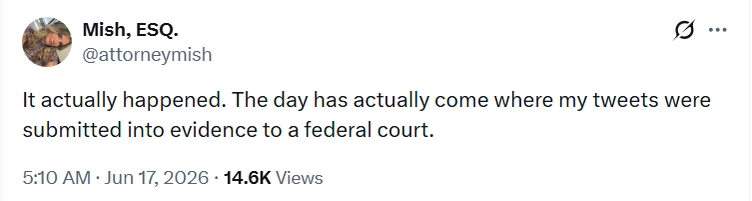
Her father also pointed out the absurdity of referring to her “colleague” and Michele had some ideas for alternatives.
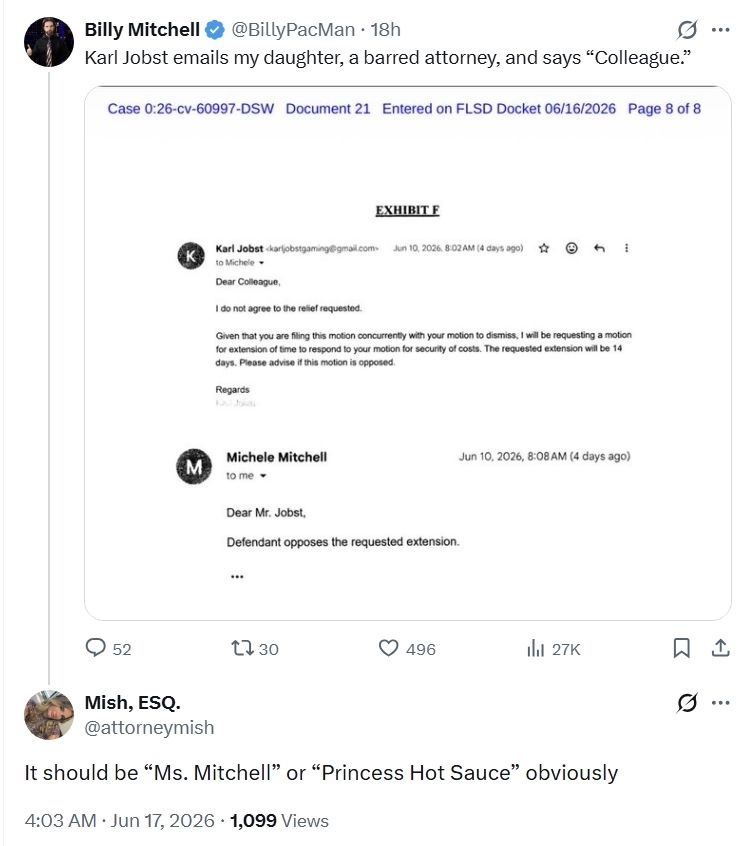
(Wait has it been really inappropriately overly familiar of me to be referring to her as Michele this whole time? Fuck, I’m also like 20 years older than her too, that’s not a good look… okay moving forward I will refer to her by preferred form of address!)
So yeah, Princess Hot Sauce(PHS) was right, the pro-Billy chuds are loving this and as well as showed that Karl is floundering it’s also making Billy stronger. Also PHS knows full well she hasn’t stepped out of line and that she gets to reply to both these motions, and then if both of them are denied she gets to file a defence.
If the court tell Karl to refile with an amended complaint, she may get to file a motion to dismiss on that one too.
She has a minimum 2, possibly 3 or 5 more free swings at Karl. 🗒️
VI. OVERALL CONCLUSION
Bit of a shit show, to put it mildly. Karl stumbled at the first hurdle and is opting to try to cover it with regular arrogance rather than humility, which is is not really going to encourage an already busy Magistrate Judge to want to take out extra time to help him with his litigation journey.
Karl doesn’t understand the legal framework, being the defendant in a single defamation case in Australia (where you lost due to a really high risk strategy) does not prepare you to be a successful pro se litigant in the US.
It’s possible the motion will get dismissed in full, but also distinctly possible that Magistrate will dismiss it in part and allow Karl to refile with a Second Amended Complaint—but also distinctly possible that will be conditional on some benefactor agreeing to put up the collateral for Karl’s costs (since I doubt the trustee will approve Karl using his own funds on it—bankrupts are supposed to prioritize paying their creditors).
Ultimately even if it somehow proceeds, its winding up to essentially be a disappointing sequel to the previous lawsuit with Billy realizing his job is to be humble before the judge and please the court, and Karl making himself look like an unhinged crusader with divine right to act above the law.
He wants to an unbeatable crusader, is generally unwilling to do anything necessary to actually becoming a such—especially if it involves humility or consideration for others (including judicial staff).
Karl and his remaining supporters mistake his mild success as a YouTuber for proof of his inherent superiority, and don’t seem to care that doing so just makes Billy seem more appealing to chuds.146Billy Mitchel (@KingOfKong) Social Blade <socialblade.com> Thus allowing him to further enrich himself.
For that reason I hope PHS successfully speedruns this fiasco. Then they can both languish in obscurity where they belong. 🗒️
- 1
- 2Karl v. Billy, above n 1, (May 19, 2026) ECF No 9 & (May 20, 2026) ECF No 10 ↩︎
- 3Karl v. Billy, above n 1, (May 26, 2026) ECF No 11 ↩︎
- 4Karl v. Billy, above n 1, (Jun 9, 2026) ECF No 16 [Motion to Dismiss] ↩︎
- 5Karl v. Billy, above n 1, (Jun 9, 2026) ECF No 15 & (Jun 12, 2026) ECF No 19 ↩︎
- 6Karl v. Billy, above n 1, (Jun 10, 2026) ECF No 17 [Motion for Bill of Costs] ↩︎
- 7Karl v. Billy, above n 1, (Jun 12, 2026) ECF No 18 [Response in Opposition] ↩︎
- 8Karl v. Billy, above n 1, (Jun 19, 2026) ECF No 20 [Response in Opposition (Costs)] ↩︎
- 9Motion to Dismiss, above n 4, at 1-2 ↩︎
- 10Karl v. Billy, above n 1 ↩︎
- 11Keller v. Miami Herald Publ’g Co., 778 F.2d 711 (11th Cir. 1985) ↩︎
- 12Horsley v. Rivera, 292 F. 3d 695, 701 (1`1th Cir. 2002) ↩︎
- 13Milkovich v Lorain Journal Co., 497 U.S. 1 (1990) ↩︎
- 14Tyne v. Time Warner Entm’t Co., L.P., 901 So. 2d 802, (Fla. 2005) ↩︎
- 15Lane v. MRA Holdings, LLC, 242 F. Supp. 2d 1205 (M.D. Fla. 2002) ↩︎
- 16Weiland v. Palm Beach Cnty. Sheriff’s Off., 297 F.3d 1313 (11th Cir. 2015) ↩︎
- 17Federal Rules of Civil Procedure, Rule 8(a)(2) ↩︎
- 18Mitchell v. Cartoon Network, Inc., 2015 WL 12839135 (D.N.J. Nov 20, 2015) ↩︎
- 19Mitchell v. Cartoon Network, Inc, above, (Nov 20, 2015) ECF No 15, at 12 ↩︎
- 20Hart v. Electronic Arts, Inc., 717 F.3d 141 (2013) ↩︎
- 21Motion to Dismiss, above n 4, at 3-6 ↩︎
- 22Horsley, above n 11 ↩︎
- 23Motion to Dismiss, above n 4, at 5 ↩︎
- 24Motion to Dismiss, above n 4, at 6-7 ↩︎
- 25Motion to Dismiss, above n 4, at 8 ↩︎
- 26Milkovich, above n 12 ↩︎
- 27Motion to Dismiss, above n 4, at 9-10 ↩︎
- 28Motion to Dismiss, above n 4, at 10-11 ↩︎
- 29Tyne, above n 13 ↩︎
- 30Lane, above n 14 ↩︎
- 31Motion to Dismiss, above n 4, at 11-12 ↩︎
- 32Mitchell v. Cartoon Network, Inc., above n 16 ↩︎
- 33Motion to Dismiss, above n 4, at 14-15 ↩︎
- 34Motion to Dismiss, above n 4, at 15 ↩︎
- 35Weiland, above n 15 ↩︎
- 36Federal Rules of Civil Procedure, Rule 12 (e) ↩︎
- 37Response in Opposition, above n 7, at 1 ↩︎
- 38Response in Opposition, above n 7, at 1 ↩︎
- 39Gertz v. Robert Welch, Inc., 418 U.S. 323 (1974) ↩︎
- 40Milkovich, above n 13 ↩︎
- 41Hutchinson v. Proxmire, 443 U.S. 111 (1979) ↩︎
- 42St. Amant v. Thompson, 390 U.S. 727 (1968) ↩︎
- 43Paul v. Findeisen, No. SA-24-CV-717-OLG (HJB), slip op, at 10-11 (W.D. Tex. Mar. 26, 2026) (R&R) [Logan Paul v. Coffeezilla] ↩︎
- 44Devin Stone Logan Paul sued Coffeezilla and it’s Crap (ft. Coffezilla’s Lawyers) (21 July 2024) Legal Eagle YouTube <youtube.com> ↩︎
- 45Logan Paul v. Coffeezilla, above n 43, (Mar 26, 2025) ECF No 74 ↩︎
- 46Trump v. Chicago Tribunal Co., 616 F. Supp. 1434 (S.D.N.Y. 1985) ↩︎
- 47Shriteh v. News Corporation, 2:25-cv-00704, (M.D. Fla. Feb 11, 2026) ECF No 54 ↩︎
- 48Rubin v. U.S. News & World Report, Inc, 271 F.3d 1035 (11th Cir. 2001) ↩︎
- 49Response in Opposition, above n 7, at 12 ↩︎
- 50Dependable Life Insurance Co. v. Harris 510 So. 2d 985 (Fla. 5th DCA 1987) ↩︎
- 51Response in Opposition, above n 7, at 3 ↩︎
- 52Response in Opposition, above n 7, at 5 ↩︎
- 53Response in Opposition, above n 7, at 3-4 ↩︎
- 54Response in Opposition, above n 7, at 5-6 ↩︎
- 55Hutchinson, above n 37 ↩︎
- 56Response in Opposition, above n 7, at 5 ↩︎
- 57Response in Opposition, above n 7, at 6-7 ↩︎
- 58St Amant, above n 38 ↩︎
- 59Response in Opposition, above n 7, at 8 ↩︎
- 60Response in Opposition, above n 7, at 10-11 ↩︎
- 61Horsley, above n 11 ↩︎
- 62Response in Opposition, above n 7, at 11-12 ↩︎
- 63Rubin, above n 44 ↩︎
- 64Response in Opposition, at 12 ↩︎
- 65Response in Opposition, above n 7, at 8-10 ↩︎
- 66Logan Paul v. Coffeezilla, above n 39 ↩︎
- 67Response in Opposition, above n 7, at 9-10 ↩︎
- 68Response in Opposition, above n 7, at 12 ↩︎
- 69Horsley, above n 11 ↩︎
- 70Response in Opposition, above n 7, at 13-14 ↩︎
- 71Lane, above n 14 ↩︎
- 72Response in Opposition, above n 7, at 14 ↩︎
- 73Mitchell, above n 16 ↩︎
- 74Response in Opposition, above n 7, at 15 ↩︎
- 75Dependable Life Insurance Co., above n 50 ↩︎
- 76Response in Opposition, above n 7, at 15-19 ↩︎
- 77Response in Opposition, above n 7, at 15-19 ↩︎
- 78Response in Opposition, above n 7, at 19 ↩︎
- 79Response in Opposition, above n 7, at 19-20 ↩︎
- 80Mitchell v Jobst [2025] QDC 41, at [74]-[75] & [533]-[534] ↩︎
- 81Motion for for Bill of Costs, above n 6, at 1-2 & 5-14 ↩︎
- 82Simulent East Associates v. Ramada Hotel Operating Co., 37 F.3d 573 (1994) ↩︎
- 83Aggarwal v. Ponce School of Medicine, 745 F.2d 723 (1984) ↩︎
- 84Re Merrill Lynch Relocation Management, Inc., 812 F.2d 1116 (1987) ↩︎
- 85Above, at [23] ↩︎
- 86Federal Rules of Civil Procedure, Rule 69(a) ↩︎
- 87Re Merrill Lynch, above n 84 at [9]-[11] ↩︎
- 88Re Merrill Lynch, above n 84, at [22]-[23] ↩︎
- 89Simulent East Assocs, above n 82 ↩︎
- 90Re Merrill Lynch & Aggarwal, above n 83 & n 84 ↩︎
- 91Motion for Bill of Costs, above n 6, at 5-6 ↩︎
- 92Aggarwal, above n 83 ↩︎
- 93Motion for Bill of Costs, above n 6, at 6-9 ↩︎
- 94Motion for Bill of Costs, above n 6, at 9-10 ↩︎
- 95Motion for Bill of Costs, above n 6, at 10-11 ↩︎
- 96Motion for Bill of Costs, above n 6, at 11-12 ↩︎
- 97Motion for Bill of Costs, above n 6, at 12 ↩︎
- 98Motion for Bill of Costs, above n 6, at 12-13 ↩︎
- 99Mitchell v Jobst, above n 80 ↩︎
- 100Motion for Bill of Costs, above n 6, at 13 ↩︎
- 101Motion for Bill of Costs, above n 6, at 14-15 ↩︎
- 102Motion for Bill of Costs, above n 6, at 16-17 ↩︎
- 103Adkins v. E. I. DuPont De Nemours & Co., 334 U.S. 331 (1948) ↩︎
- 104Carbone v. Cable News Network, Inc., 910 F.3d 1345 (11th Cir, 2018) ↩︎
- 105Erie Railroad Co. v. Tompkins, 304 U.S. 64 (1938) ↩︎
- 106Florida Constitution, Art 1, §21 ↩︎
- 107The Psychiatric Associates v. Siegel, 610 So. 2d 419 ↩︎
- 108Lasky v. State Farm Insurance Co., 296 So.2d 9 (Fla. 1974) ↩︎
- 109Response in Opposition (Costs), above n 8, at 1 ↩︎
- 110Response in Opposition (Costs), above n 8, at 1-2 ↩︎
- 111Response in Opposition (Costs), above n 8, at 2 ↩︎
- 112Carbone, above n 103 ↩︎
- 113Response in Opposition (Costs), above n 8, at 2 ↩︎
- 114Simulent East Assocs, above n 82 ↩︎
- 115Response in Opposition (Costs), above n 8, at 2-3 ↩︎
- 116Response in Opposition, above n 8, at 2 ↩︎
- 117Simulent East Assocs, above n 82 ↩︎
- 118Response in Opposition (Costs), above n 8, at 3 ↩︎
- 119Re Merrill Lynch, above n 84 ↩︎
- 120Above, at [23] ↩︎
- 121Above, at [12] ↩︎
- 122Response in Opposition (Costs), above n 8, at 3 ↩︎
- 123Aggarwal, above n 83 ↩︎
- 124Response in Opposition (Costs), above n 8, at 3 ↩︎
- 125Aggarwal, above n 83 ↩︎
- 126Carbone, above n 103 ↩︎
- 127Aggarwal, above n 83 ↩︎
- 12828 U.S. Code § 1915 ↩︎
- 129Aggarwal, above n 83 ↩︎
- 130Response in Opposition (Costs), above n 8, at 3 ↩︎
- 131Response in Opposition (Costs), above n 8, at 3-4 ↩︎
- 132Psychiatric Assocs, above n 207 ↩︎
- 133Response in Opposition (Costs), above n 8, at 4 ↩︎
- 134Response in Opposition (Costs), above n 8, at 4 ↩︎
- 135Aggarwal, above n 83 ↩︎
- 136Response in Opposition (Costs), above n 8, at 4-5 ↩︎
- 137Response in Opposition (Costs), above n 8, at 5 ↩︎
- 138Mitchell v Jobst, above n 80 ↩︎
- 139Aggarwal, above n 83 ↩︎
- 140Mitchell v. Cartoon Network, above n 18 ↩︎
- 141Response in Opposition, above n 7, at 15 ↩︎
- 142Response in Opposition (Costs), above n 8, at 5-6 ↩︎
- 143Response in Opposition (Costs), above n 8, at 6-7 ↩︎
- 144Response in Opposition (Costs), above n 8, at 7 ↩︎
- 145
- 146