Released at the same time as Wonderfilled Presents: GiantLands: Tuskaloosa’s Reckoning: The Sun Sword: Part One, (Tuskaloosa’s Reckoning)1Stephen Erin Dinehart IV “Tuskaloosa’s Reckoning: The Sun Sword: Part One” (Wonderfilled Inc via Amazon Print-On-Demand, Lake Geneva WI, 2025) this is the long awaited introductory module for GiantLands2 Stephen Erin Dinehart IV & James M. Ward “GiantLands” (Wonderfilled Inc, Lake Geneva WI, 2021) and allegedly the final work of James M. Ward. (Jim or Jim Ward)
I say allegedly because from my observations it seems Jim stopped working on it in 2022 at latest, the product I read didn’t really mesh with the way it was described by Jim (videos now deleted) or the session he did on a video call, supposedly covering the opening of the module.
Much like Tuskaloosa’s Reckoning it seems the primary authors are Stephen Erin Dinehart IV,(Dinehart) and a collection of video cards running a Large Language Model. Almost none of it is connectable to Jim’s video call playthrough, and that which is has been re-written to become unrecognizable for those familiar with Jim’s work.
The product seems to be an attempt to do a soft re-launch of GiantLands, but to make it focused around the co-released Tuskaloosa’s Reckoning with no real connection to the events, characters or ideas in that novel. There are surface level references, but nothing about the core plot of aliens invading, destroying sacred places to steal the Ley energy or even Gaea and her champions.
In fact, it creates a weird alternative version where characters like Dinehart’s own self-insert can only be understood as having just idly sat by and watched it all happen from their ivory tower, and undermines the significance of the Jim Ward insert.
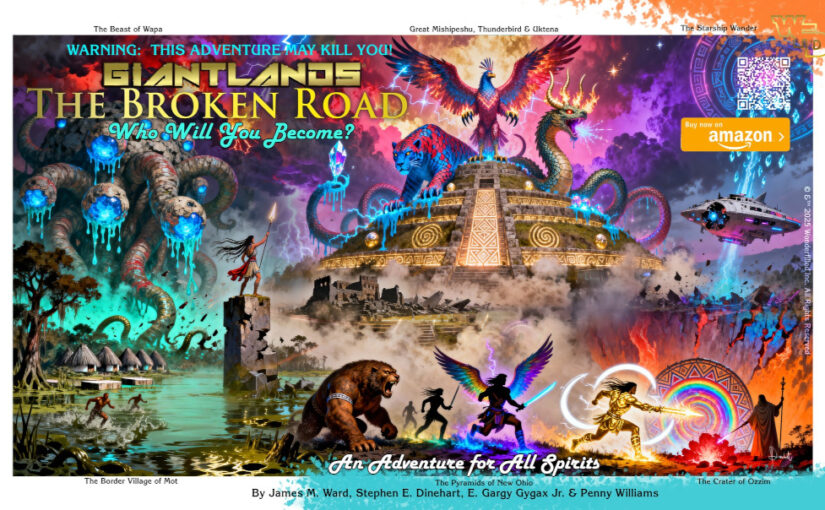
This review is from the hardback copy of GiantLands: The Broken Road (The Broken Road)3 James M. Ward & Stephen Erin Dinehard IV “GiantLands: The Broken Road” (Wonderfilled Games via Amazon Print-On-Demand, Lake Geneva WI, 2025) I ordered on 30 November 2025. It is, hopefully, the final part of the GiantLands Saga.
Table of Contents
I. THE ADVENTURE
The adventure is the GiantLands version of The Cult of Abaddon:4 Vincent Florio “The Cult of Abaddon” (TSR LLC, Lake Geneva WI, 2022) The party arrives at a village and is recruited into finding out why the water is killing people, it turns out to be an absurd convergence of affairs they have no reason to have any investment in. The party will probably be killed before they uncover material elements of the plot, but even if they finish the adventure they will still not uncover anything worth reading about in the plot.
This is a terrible basis for an introductory adventure because it essentially reduces the party who are supposed to be engaged in heroics into errand running mercenaries and a clean up crew for a chemical spill. (People who do volunteer to clean up dangerous chemical spills are heroes, but not in the table top role-playing game (TTRPG) sense).
Unlike Cult of Abaddon, the peril is not immediately that the party will die if they don’t fix it (though it does leave it open for that), but guilt trip over NPCs dying and also the chief of the town you just arrived in told you to do it. Honestly, I’m not sure which is a worse motivation, but both essentially rely on “You gotta do it or everyone and/or you dies!”
The absence of choice, and the appointment of the role as saviour by the module eliminates the capacity for heroism by eliminating the player agency. The adventure is thrust upon you and you are required to do it, you can’t choose to be a hero, you must just be a cog in the machine.
It is, however, several degrees worse for while Vincent Florio (aka The Evil Dungeon Master) is a fundamentally incompetent writer, incompetent storyteller, worse game designer, toxic personality and completely inept at understanding TTRPGs: he did at least make it a clear and intuitive objective, to kill the bad guys.
At no part of this adventure, is there ever really a clear objective. Even worse, the entire premise shifts without announcement throughout the module. ⬆️
A. At Least 2/3rds Filler
One thing that stood out to me was that, when I watched Jim run this module – it starts with you on the road – already heading up the river. In this module you first get the rules of GiantLands explained to you, some new rules added, more about how to run an adventure explained, rules for the weather, then you finally get to start the adventure on page 31.
For the uninitiated: generally modules intended for new players are less than 20 pages long. Many iconic modules for adventures with simple premises are 15 pages. The only module I have that takes this long to get started is the 5E adaptation of mega-dungeon Caverns of Thracia,5 Jennel Jaquays with a 5E Conversion by Scott Moore “The Caverns of Thracia: A Fifth Edition Conversion & Classic Homage” (Goodman Games, 2024) which understandably includes interviews and tributes to Jennell Jaquays in the module that pioneered jaquaysing.
The vast majority of coherent story is resolved by page 68, so that’s 37 pages of 154 pages. There’s a few more pages you need to resolve it, don’t really resolve much and the directions from this point don’t make sense. It has few maps, and the maps it does have just make things less comprehensible.
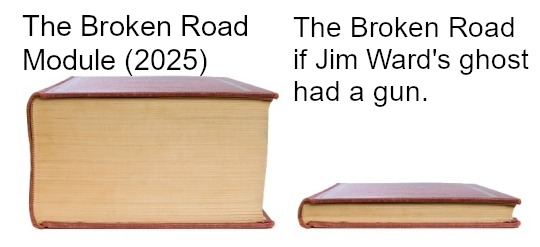
But even that doesn’t do it justice just how badly assembled this book is an how inefficient the communication is. Especially given the earlier promises were it would be 60 pages.6 Stephen Erin Dinehart IV “GL1 The Broken Road Giantlands Adventure Module (PREORDER)” (Wonderfilled Games Shop, Wonderfilled Inc, Lake Geneva WI, 19 June 2024) <archived>
Numerous locations and non-player characters (NPCs) are introduced, then re-introduced multiple times with conflicting information. Summaries are provide for places the party will never go, and an entire area seems to be there just to tie in with Dinehart’s failed attempt to be a house/funk musician.7 Stephen Erin Dinehart IV as Professor Prism “Detroit Booty Temple: Temple of Booty” (Wonderfilled Inc, Lake Geneva WI, 2025) <templeofbooty.com>
The content that is there, often simply has paragraphs of cringe attempting to build drama around something that isn’t described in sufficient terms for a Games Master (which GiantLands refers to as Spirit Keeper) (GM) to answer basic questions like… “What does it look like?” ⬆️
B. Not Fun To Play
I haven’t played this, in part because I don’t know 4-6 people who would enjoy playing GiantLands. This isn’t a unique issue, there doesn’t seem to be that many people who actually like the game. More importantly though, I would consider it unethical to subject people to this module when it is so transparently bad.
The first engagement that the GM has with the players that is not simply reading to them, is telling them they need to make a saving throw or they’ll vomit from being sea sick on the boat they’re on for no particular reason. Characters are described primarily in reaction to specific prompts, challenges just list ability/skill checks to be applied (no matter what the players do) and complex concepts are raised but then glossed over, essentially just dumping more work on the GM.
While the fluff before the adventure stresses that player agency should be the priority, there is simply no opportunity for when the text advises that the solution will require x test. Encounters are frequently written where the option is grovel for a non-lethal option or die in combat, and general information mostly assumes that all parties are murder hobos and the GM should punish them for it (despite the lack of literally anything else to do).
It is not pronounced as it was in Tuskaloosa’s Reckoning, but there are definite indicators that large parts are written with generative AI. This results in paragraphs which are self contradictory and/or simply reduce an entire encounter to a dice roll. ⬆️
C. Non-sensical
The plot is both on rails but also simply incomprehensible and falls apart immediately after Part 2 due to a failure to make sure the map fits the story in the most basic manner possibly.
I assume this is an artifact of Dinehart reworking Jim’s work until pretty much nothing remains, but the crater which is supposed to be the ultimate source of pollution at the end of the path is nowhere near the path. Areas on the map are essentially unreachable and parts contradict each other.
Early on we are told that most people in the GiantLands setting will never see electricity or a computer, but then the initial town is occasionally visited by alien hovercrafts, the NPC you can (or can’t?) recruit has a phase rifle, and early in the piece you come across Andros (robot people) using a 4th age facility that has an electric fence.
The initial area suggests adding 2 NPCs to the party but they are forgotten outside of Part One, meaning they will essentially just be a burden since the module is clear that if they die it will be bad for the party.
Throughout the story, ridding the world of the contaminant alternates between being clearing up super pollution, healing an ancient living god or enacting genocide (the book uses that term).
Pretty much all the setting information is either contradicted by other material, or so counter-intuitive such as sacred areas that are protected always being full of scavengers looking for things from the 4th Age… for not particular reason. ⬆️
D. The Broken Road
So, the titular element of the module, “The Broken Road” is the remains of the various highways built in the 4th Age (basically the current day and/or near future). All the information on this fits onto 1 page, and there’s no real straight forward to incorporate them into the adventure.
Because, for reasons that are not clear. They are listed as both highly advantageous for traders and travellers, but are also too dangerous for even adventurers to use.
It’s, very strange and seems to indicate that originally the plot of the module was going to be having to travel these highways for some reason (until presumably they settled on poisoned rivers for some reason).
So going by the title, it’s a terrible supplement that amounts to 1 page hidden in a book. ⬆️
II. BLOW-BY-BLOW
So, to give you a full overview of how bad it is – I should tell you what’s in the module in the same way an essayist might go over the broad strokes of a novel or movie. It’s really the only way to appreciate how absurd it is as a “quick intro module” or an introduction to the setting.
Every area has a laundry list of problems with it, and I worry that by glossing over them I undersell how incoherent a mess it becomes. You just can’t really appreciate how badly presented the narrative(s) are until to try to map it out in your mind.
This is by far the strongest indicator of AI writing and the hazard. By not taking the time to work it all out himself, struggle with obstacles and engage with the friction of creativity – Dinehart becomes completely oblivious to what the experience of the reader is.
The primary appeal of these deep dives, to me, is to work through the elements and thus increase my understanding of what to do right by looking at what went wrong. The thing that has become obvious to me through all the examples to date is the slop creators are simply unwilling to examine their own work. ⬆️
A. Part One: The Village of Mot
For reasons never explained: the party begins on a boat crossing an inner sea to reach this village so they can be asked if they have arrived to fight, or live. The instructions say this question should hang over them, but they won’t get a choice anyway – they’re adventurers so of course they’re going to fight, and this is GiantLands so of course they’re not going to live.
The main opportunities in the village are beer (which is poisoned, but also a healing potion) and hauling barrels of water to the brewery (which doesn’t use water from the river that you fetched it from). It is also a strange area since NPCs listed here all have a “reward” they will offer. This heavy focus on beer seems to entirely due to jokes made by the party in the Jim Ward playthrough about just going back to the tavern to “have an ale”.
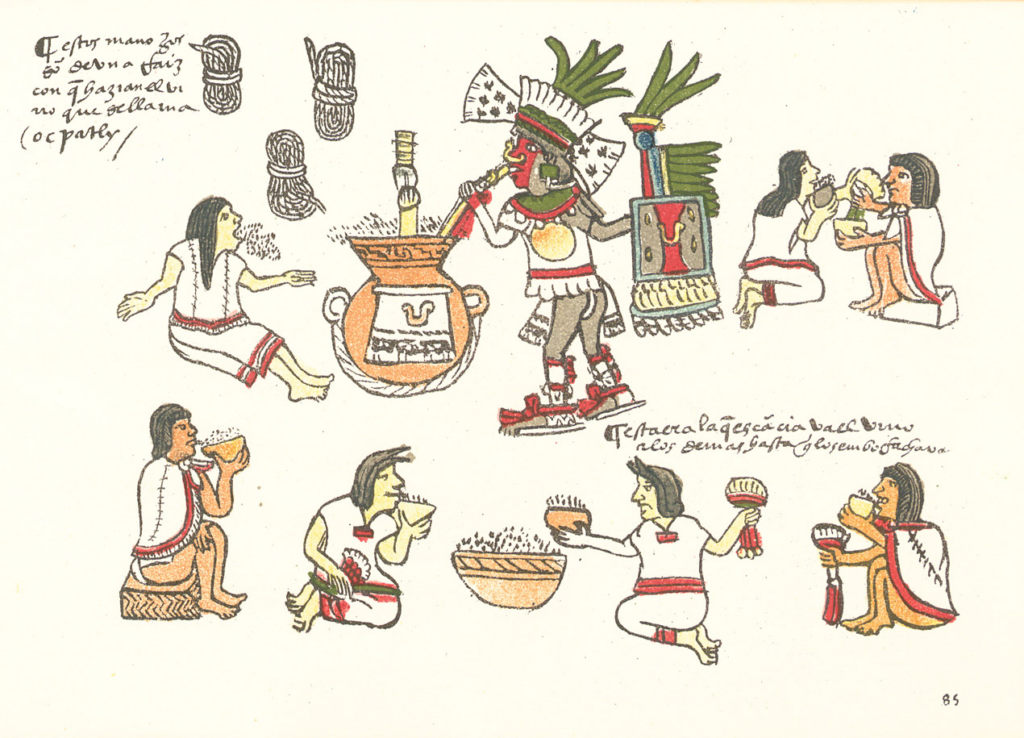
The choice to make the focus of a Native American themed module begin with a strong focus on brewing alcohol that may or may not be great or poison is not optimal, in my humble opinion. Particularly given there is no focus on the particular ways indigenous people in the Americas brewed and engaged with alcohols.
.jpg)
One of the NPCs is a 16-year old boy whose father was the brewer, but died, and he’s now hanging out. There is nothing in there about any other family he may have, his relationship with the apprentice brewer who took over, etc but there is a note that he should ask the questions the party forgets to. Basically he’s Clippy.

The other is a guardian who can give them a map to the tunnels beneath the city… which are not otherwise included or elaborated on in the module, and who can be recruited or maybe not. Either way, she is not mentioned again in the module.
Please, read this and tell me if she does or does not join the party.
“Join you” she says, setting down her pint. “You barely know how this place works. But… you have guts. Maybe that is enough.”
“This is not my fight anymore. Good luck.”
She returns to Mot and does not rejoin unless circumstances change dramatically.
Because the text tells you she can be recruited, if you ask her directly – and that’s her response to being asked directly – and that the party respects her she’s an invaluable ally. But the response clearly says she snubs them.
Collecting and transporting water is presented as some sort of sacred duty, but also a chore that is given to expendable outsiders due to the presence of a “guardian” who attacks the party when they’re trying to collect water. The encounter is so unbalanced it relies on the city guard joining it to save the party, the opposite of heroism or demonstrating worthiness.
Succeeding in not being killed during a battle with their guardian leads to the village chief appointing the party as the chosen ones to end the contamination. The contamination that was previously speculative but that threatens the town the party just arrived at and used the party as an expendable water gathering device. ⬆️
B. Part Two: The River
This is just a few encounters at non-designated points in the journey up the river which ends with a Fountain of Youth, that is not a fountain and does not restore youth (just heals you) then there is an unclear “fork” where 1 encounter lets you likely total party wipe, and the other lets you… resolve the plot.
In preparation for this, I subjected myself to the full play-through that was done via video call in December 2022,8 “Tabletop Session 1: GiantLands GL1 “The Broken Road” with James Ward 12/10/2022″ (GiantLands, YouTube, 10 December 2022) <https://www.youtube.com/watch?v=4UzyKW6ESZ8> and I it is initially very difficult to see how this is supposed to be the same module as what Jim was running. Eventually, toward the end, there is one encounter that fits the session – kind of.
The book calls them Nunnupi and they’re basically trickster gnomes who try to steal something and throw rocks at you, and if you put up with that they’ll decide you’re cool. If you don’t put up with that shit, they’ll shoot you with poisonous darts that do slightly more damage (if you fail your save). This makes them less creepy, “not evil” versions of classic Dungeons & Dragons monster: Jermlaine.
In Jim’s version they’re just rob you for all your food, blow dart guns at the ready – pretty much guaranteed to kill 1 or more PCs if there is any resistance since they’re save vs poison or die.
So this seems to be verifiable piece of Jim Ward adventure, defanged and re-written so that it’s beyond recognition. That’s not great in a product marketed using Jim Ward’s name. ⬆️
C. Part Two: Supply Depot
This part represents a major deviation from the Jim Ward playthrough. In Jim’s version, you find the depot after you find the spill – which makes sense because you were following the river, so you would find the spill first then the facility.
In this version, you find the depot first and it’s populated by a collection of sentient Andros (robot people) who can be called to the gate, be negotiated with, and have their own robot guard dogs as well as electrified fences, automated energy weapon turrets and… it’s hard to understand how people in GiantLands don’t know about about electricity or computers.
The supply depot houses barrels of the contaminant which the Andros collected from a meteorite for no reason other than they are not harmed by the contamination. It’s very strange, and introduces a character who should be complicated and well. Here’s all the information:
An off-world Andro and the colony’s science advisor. He is aware of the contaminant’s origin. He may be persuaded to share secrets if approached with gifts, respect, or proof that the Spirits are not a threat.
That’s it, that’s all the information you are given for this character, who is central to resolving the jeopardy, and has a (literally) alien background. This is bizarre and ridiculous on a fundamental level. Like we’re at about 40% of the way through the book at this point, but this was massively deprioritized for stuff that will far, far less relevant.
In the playthrough Jim Ward did, the supply depot was operated by robots that were simply operating on their old programming, devoid of personality and simply remaining tools of a bygone era. The supply depot is loaded with all the loot that a starting party would need to progress themselves.
In the final version, it is loaded only with the contamination which has penalties for improper disposal and pointless lore (that is contradicted later) but no guides for safe disposal it. Also the path to the actual way it ends up in the river. ⬆️
D. Part Two: The Truck and Waterfalls
So, if you don’t get killed by the supply depot, you can find the truck which is at the waterfall and the players really can’t do much.
In the Jim Ward playthrough, his expectation is they would investigate the truck – find the dead driver, and also find his remote that would allow access to the supply depot. That would lead you to the next place and give you a means of entry.
The published module simply reduces the party to the job of untrained toxic waste clean-up staff. Remember, the player characters are supposed to be oblivious to modern concepts to electricity, computers and presumably techniques for dealing with an S-tier biohazard.
The truck in this version is unmanned, was left in the river by the Andros (who scavenged it from the supply depot) and just essentially abandoned since it is harmless to them (and apparently they had no real use for the contents). No analysis is given as to the degree of blame we should assign to them, probably because no motivation is given to the Andros for collecting it in the first place.
Ultimately though, it is a fundamentally pointless encounter since there is no solution other than to keep failing until a local megafauna spirit guardian that is not described beyond its motivations, and capacity to just fix this problem now someone else is trying to.
This creature didn’t appear in the Jim Ward play through, and doesn’t feel very Jim Ward. For all my issues with Jim, I give him credit that he always wanted the players to be the ones who solved the problems, never to have an NPC just come in and fix it for them.
Nothing past this point is even hinted at in the Jim Ward playthrough, we are at page 67 of 142 (not counting pages for notes, map templates, credits, etc). Just under 50% of the material if we include the recap and revisions to the GiantLands rules. ⬆️
E. Part Three: The Broken Road
The titular feature is introduced after the party essentially resolves the problem they were commissioned to do. It’s a singular page, and the main thing that stands out is it feels almost entirely AI generated.
Particular areas of The Broken Road are presented in random order with a paragraph of prompts that essentially require the GM to do all the actual work. Because coming up with ideas like “They offer maps to places that might not exist. Some maps lead to treasures. Others lead to madness.” is the easy part. Making up the specifics of those maps and deciding on the outcome, the signalling and the options throughout it is the actual work.
This kind of laziness of providing prompts instead of information continues throughout the module, particularly after this point.
The singular highway the party will travel on is not covered. The only point of interest here is that it seems to assume the party will not use any of the various exotic species that GiantLands offers as there is a doppelganger type encounter option which assumes they are all Sapiens.
Notably the only highway that the party does travel on, the I-75, is not included in the list. ⬆️
F. Part Four: Indy
This definitely seems to be an area written entirely from scratch after the passing of James M. Ward, and not inclusive of any substantial portion of his work.
The introduction depicts the ruins Indianapolis as some sort of hellscape, (literally) uninhabitable ruins populated with mutants, three-toed monsters and mysteries. It stresses this is a transition from spiritual trials to mutants and madness.
Then there’s a random encounter generator that doesn’t provide any details you’d need to actually run an encounter (such as information on the mutant factions, stat blocks for the mutants, etc. You are literally expected to work out the entire meat of each outcome of the rolls yourself.) There is a radio tower encounter that is entirely skill checks, controlled entirely by random outcomes.
After that you move right on to three spiritual trials. Yeah, Indy itself is practically non-existent, unplayable for lack of development and devoid of any sort of intentionality. None of the elements that are set up are paid off. ⬆️
G. Part Four: The Trials
This is perhaps the most cringe part of the module, which is saying something.
At this point, and this point only, it randomly injects the use of Tsalagi, the language of the Cherokee people, in a clumsy fashion and while it has some stern statements about not to treat it lightly, it does not walk the walk.
The three “trials” are meetings with creatures that are sacred and divine to indigenous people, starting with the Thunderbirds. This is certainly a choice given the fiasco that Monte Cook Games inflicted on themselves by doing this carelessly, and that Dinehart is so careless the text refers to “Thunder Boys” at one point, not distinguishing between the two concepts.
These beings are presented stat block first, and all have a “trial” they present which can range from answering a question or offering a bribe to pass a skill check roll or just merc them. Weirdly this is later explained as representing the cosmology of GiantLands – though Gaea, the supposedly central goddess of GiantLands, is not mentioned anywhere.
This is also incredibly uncomfortable since the two of the three beings come not from Cherokee, but Ojibwe people. There is a Cherokee word for a mythological giant raptor, and the Cherokee do have Thunder Boys who are tied to Uktena.9 Robert Lewis “Traditional Cherokee Story: Uktena and Thunder” (Cherokee Nation, YouTube, 13 July 2024) <https://www.youtube.com/watch?v=7DsA30UeaIg> But the word provided by Dinehart does not match and evades my searches for it, it seems to be a hallucination of AI.
I am not an expert on indigenous cultures, but of this much I am certain – it is vulgar to include the sacred and divine beings of living people as a type of boss fight/trial of worthiness and it is vulgar to claim to represent an indigenous group and demand respect for it while diluting their culture or inviting misrepresentation and misunderstanding.
The trials add nothing to the adventure, nothing to the depth of GiantLands and seem there only so Dinehart can brag about how he injected indigenous culture into the game, but asking ChatGPT or some other AI to approximate it for him. ⬆️
H. Part Four: Enter Jim Ward
Having finished blaspheming against the culture he claims to love, Dinehart now moves on to blaspheming against the hobby the claims to love. There is a Jim Ward insert, and it is stressed twice he is “not evil, but he sees the world through the lens of lost empires.” I am particularly confident this character was not Jim’s idea since it departs from the long hold tradition of the names of the insert characters being anagrams and simply labels him: Jamzoid Wardius.
This terrible name, which is so bad that even the module just uses JW instead, leads me to believe at one point Jim was meant to be part of the Detroit setting. Jamzoid would at least have some entertainment value if associated with music.
While the charitable explanation is this is Dinehart trying to get closure on the friction between his own politics and Jim’s staunchly conservative (Wisconsin conservative at that) beliefs, it reads as condescending in the extreme. Jim has a stat block, but also the ability to insta-kill everyone via “TPK (Total Party Kill)” ability, and also is there basically to explain the story and the setting.
This entire discussion takes place back in Indy (which you have since left), far from where the real Jim Ward lived. There is a cult of mutants who use hand signs, which may be an inside joke or may be the result of Jim fucking with Dinehart for fun. It’s all very strange, and not much of a tribute to a man who supposedly meant so much to Dineheart. ⬆️
I. Part Five: Annod
This section was definitely added later and has all the hallmarks of vibe writing via generative AI. There is a spaceport, which is introduced at the start as being a ruin long disused and then, when you get to it “no ruin” but a fully functioning and flourishing space port. It’s just slop filler in its purest form.
The entire point seems to be to pad out with some extra NPCs, another temple, extra tables, extra markets and for Dinehart to masturbate over his Manquatti creation. None of it has anything to do with the core plot, and the “blue water sickness” mentioned previously is also never touched on in the material itself.
There is however, a guy selling a barrel of the contaminate as a panacea. ⬆️
J. Part Six: Savana
This is just travelling across the grassland, since the adventure is apparently on rails and the party must go where it tells you to.
The first encounter is with legally distinct Flumphs, who are able to offer some sort of weird solution to the problem even though this is 1. the mid-point of the adventure; and 2. you already had a chance to kind of solve it. Like this 1 encounter re-writes the whole module to be about these guys, and that the contamination is actually their unborn children.
It’s very strange. But becomes transcendent when you read the [GM] Notes where it describes one of the options as “genocide” and almost immediately stress that none of the options are wrong. It’s the sort of thing you’d expect to find in an edgy parody of the ending of Mass Effect 3 or maybe a module for Macho Women with Guns.
Then there’s more AI slop commodifying and gamifying the spiritual beliefs of the Mound Builders, with a “speaking” mound that is just a giant not-a-Flumph. The party also go to a dance party with birds, literally, that’s a thing the party can do. ⬆️
K. Part Seven: Hopi
Having nothing to do with the Hopi people, this is also a section that is transparently added after Jim Ward’s passing – with the town gatekeeper being a cameo of the player character of Dinehart’s childhood friend/lawyer in the Jim Ward run.
This also includes the opportunity to engage in “Black Drink” spirit quest as happened in Tuskaloosa’s Reckoning. This comes with example spirit quests that are summarized in single paragraphs. Essentially this is low effort tourism of indigenous beliefs, and thus the commodification of culture. ie bad.
Otherwise, it’s got at a temple, it’s got a bath house and an enemy that just drops out of the sky as a flaming meteor for a boss fight with the party – completely unprompted.
Just to be clear, that’s not an exaggeration or me taking the piss, that’s a real encounter that is inflicted on the party right after they get a chance to heal up etc. They don’t even get to leave the city and they get all their recovery undone by a boss fight described as a “fiery comet crash”.
It’s not entirely clear to me if this was inspired by Starscourge Radahn from Elden Ring, the creature also has horns kind of like his, but I do know it’s very strange. The loot is a horn that lets you summon fireballs from the sky, and that’s even stranger.
At the end you can travel the I-75 to Detroit, reaching it in 1 day despite it being much, much too far away to do that and that the I-75 doesn’t connect to Hopi. ⬆️
L. Part Eight: Detroit
At the front of the book, Detroit is described as a place where society has rebuilt, but the squabble for power makes it intensely and dangerously political. The sort of place for an intrigue campaign. It is, definitely not that.
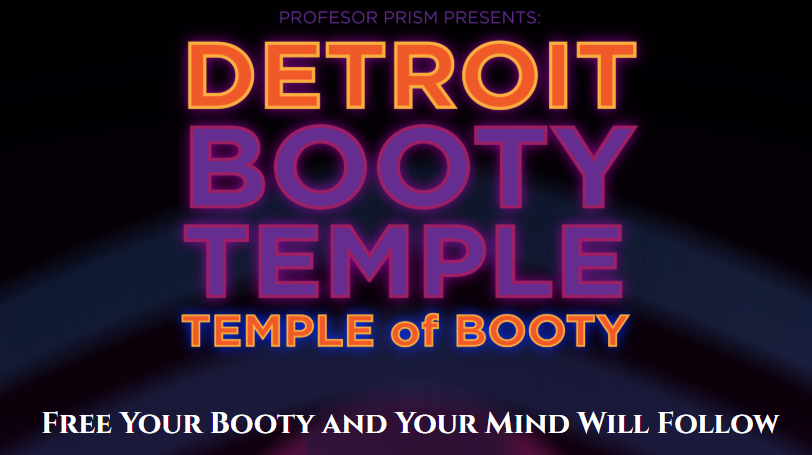
The obvious influences for Detroit are Dinehart’s own terrible aesthetics, his terrible AI music “Detroit: Temple of Booty” album and two songs that everyone who is old enough to remember Old School gaming will remember. The first being the obvious influence for the marketing of his terrible AI generated album:
Though you need to include the lyrics from the original opening that Ice Cube clearly wants us all to forget:
At these uptight times, hardcore funkateers before the bop gun
We unleash you a positive light
The bop gun can do you no harm
It free your mind, so your behind can follow
No, seriously.
And the second being the one that inspired his self-appointed title, and his self insert.
Dinehart’s NPC insert is “The Funkfather”, a title which seems immensely disrespectful not just to James Brown but to the genre of Funk, Black American culture and music in general.
In the final version of Detroit, it is simple a temple to the musical whims of the Funkfather who does not have a stat block because Dinehart absolutely does not want people trying to kill his self-insert. Rather his self-insert is some sort of living god with the power to summon magical trams, roll a 1 on 3d4, etc. (Yes there is a table to roll 3d4 on, it starts at 1 and it caused me psychic damage.)
The entire thing is slop that doesn’t fit into the story, offers frankly baffling options. Do you want to go to the final area, or return to the village without completing your mission but with the title of “Bearer of the Beat”. ⬆️
M. Part Nine: Ozzim Crater
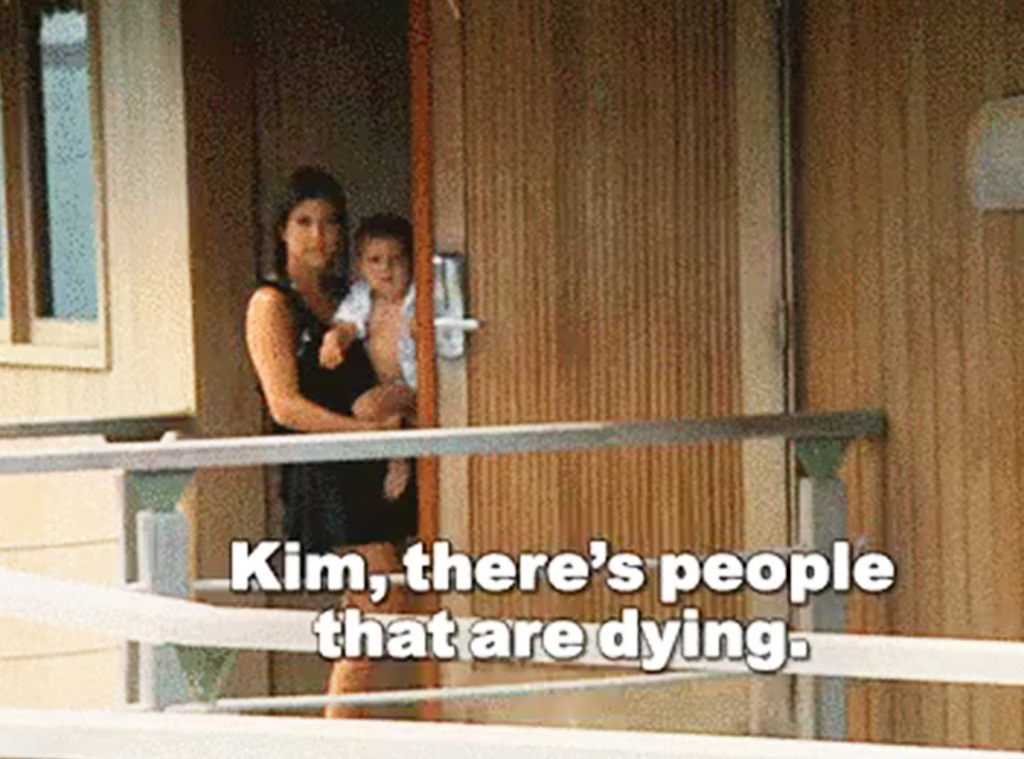
You then “carry on to Ozzim Crater” (assuming you remembered there are people that are dying), which is nowhere near Detroit and discover the source of the pollution after dealing with a robot that I think is a Star Wars Day joke, or maybe a reference to Cinco De Mayo.
The robot isn’t the real spectacle though, that’s the crater and the giant space ship which is in the middle of the crater. Now the blue ooze is no longer an industrial pollutant, or a new life form, but the tantrum of an ancient giant who is a guardian of the world and trying to heal it through destroying it. Oozing out of his space ship and spreading… somehow.
This encounter is one of the most anti-climatic in the module, with much less effort put into it than the boss fight with the guy who literally falls from the sky. The clear solution is for the party to talk to him, remind him he’s the good guy and then he will literally solve the problem and dissolve into light.
Then the party can go back to the starting village to receive honours, etc. ⬆️
III. MUTATION AND MADNESS (IS IT A JIM WARD PRODUCT?)
Now, for the rest of this I’m going to have to say things that are fundamentally unkind because the observable facts are fundamentally unkind to Dinehart. But before I do that, I want to cover what is probably the sole point of interest to the old school gaming crowd: How much Jim Ward is in this?
The answer, in my estimation, is less than 1% of this product is Jim Ward. I feel confident that Dinehart will dispute that – after all its in his interests to claim association to Jim. But I think the most illustrative example is in the difference of the playthrough vs the end product.
See, one of the few elements that was actually compelling in GiantLands was how did Jim Ward, the original author of Gamma World, and a staunch conservative, approach a game about healing nature after an apocalypse caused by the Earth Goddess’s righteous fury at humankind?
In the original playthrough, the contamination is connected to how it happens in real life – carelessness by people who never stopped to consider the consequences, perpetuated by unthinking and uncaring machinery (physical and political). This, while avoiding the complex political arguments about incentives, etc, feels right. The kind of thing Ted Turner could get behind.
All of that has been erased in the meaningless expansion to raise “big questions” that are fundamentally irrelevant to the GiantLands core ideal. The contamination is now:
- Being spread by alien robots who are doing it for not particular reason other than it doesn’t hurt them; and
- A new form of life which will happen to manifest as an existing form of life, by growing from a bacteria into a legally distinct Flumph; and
- The accidental side effect of an alien crashing their spaceship into the world after the cataclysm; and
- A mistaken attempt to save the world by purging it of life in another cataclysm.
All of these, feel like bullshit. The kind of absurd nonsense that someone who wants to appear interested in a big issue invents to avoid having to deal with it. Dinehart, who claims he’s making a game about protecting the world, is less willing to engage with the threat to the world than Jim Ward.
The mutation of the product has certainly crossed the threshold where one could honestly recommend it as a Jim Ward product. In addition to what work he did being diluted and re-written to be unrecognizable, gone is the playful threat of a TPK through reckless decision making. The Jim insert just threatens you with them upon meeting them, and inflicts them via fucking magic.
In his eulogy post on Facebook, Tim Kask felt the need to specify that Jim was not an unfair DM, rather he was a DM who delighted in setting traps with compelling bait.10 Tim Kask (Tim Kask (Kaskoid), Meta née Facebook, 19 March 2024) <facebook.com/tim.kask.9> In his playthrough, regardless of you opinion of the viability of them, Jim always stresses there is a solution and is happy to disclose it after the fact.
The final product is a module where risk is completely arbitrary and the solution is often given simply as a skill check – no role-playing, investigation or innovation required. You simply show up and if you try to do that thing, make a Mind Check. If you pass, you do the thing. If you don’t, either nothing happens or you have some sort of penalty that ranges from trivial to game ending.
That isn’t a module where you can tease people about, “Remember what I told you when you arrived, what are you missing? What haven’t you tried?” Or cackle with glee and say, “Yes, that’s a great idea.” when they announce they pull the trap lever.
The final product is, in my opinion, less than 1% Jim Ward – such that you would probably get an more authentic product made entirely by a fan of Jim’s work and his design principles. ⬆️
IV. BUT IS IT GOOD?
Let’s be real, if you’re reading this far you already know the answer to that and are reading to hear all the ways in which it is not good. I also credit you with the capacity to read the table of contents and inferences, but I want to explain this is far from everything.
On any given page, there is at least one disaster I could write a short blog entry to explain. There are paragraphs everywhere that could be highly entertaining as a dramatic reading followed by context. There is the constant arrogance combined with condescending tone.
Most of the problems, the real problems, are also ones that simply cannot be undone. The lazy provision of prompts rather than material can only be fixed by a brutal re-write to omit them, or inflating the size of the already bloated module many times over. The developmental issues require drastic changes in the story and the supporting material.
It can’t be saved, and here’s a few reasons why. ⬆️
A. The absence of edits
A constant with these products that are made with the use of generative AI is that while proponents claim the key is “extensive editing” the reality is none of the people do the editing for the same reason they don’t write it themselves, too much work.
This product shows the hallmarks of a lack of editing of all kinds, despite including multiple editors in the credits. I do not judge the credited editors for this, for no editor can actually fix bad work and I am confident Dinehart did not manage the workflow in a way to maximise their input. Editors can do the mark ups, but the author is the one who must make the actual edits.
The Developmental Editing is clearly absent as it is consistently chaotic in the delivery of information, has large areas that contradict each other and constantly introduces things that are immediately forgotten. A module that had less areas, but more development with better front loading of information would have been vastly preferable to this mess.
The Line Editing is pretty much non-existent, with the work often including outright statements of “tell, not showing” to be read to the players (most notably the insistence that the Jim Ward insert is “but he sees the world through the lens of lost empires” and uses theatrical and dramatic “show, don’t tell” in the notes for the GM.
The Copy Editing. Well there’s two obvious spelling errors literally on page 1, and it’s really unclear what purpose is served by having a Copy Editor but no Line Editor when the only thing that generative AI is generally reliable with in consistent spelling and grammar, and Dinehart doubtlessly did re-writes and other changes after copy editing.
Proofreading, also didn’t happen as there are instances of 2 paragraphs missing the line between them, more than one instance of a paragraph ending with “\” as well, the page numbers in the guide don’t match those in the in the table of the contents and the table of contents. You’ve probably found multiple worse errors in this post, but this is a blog post I put up for free – not a printed product I charged money for. Also, well:
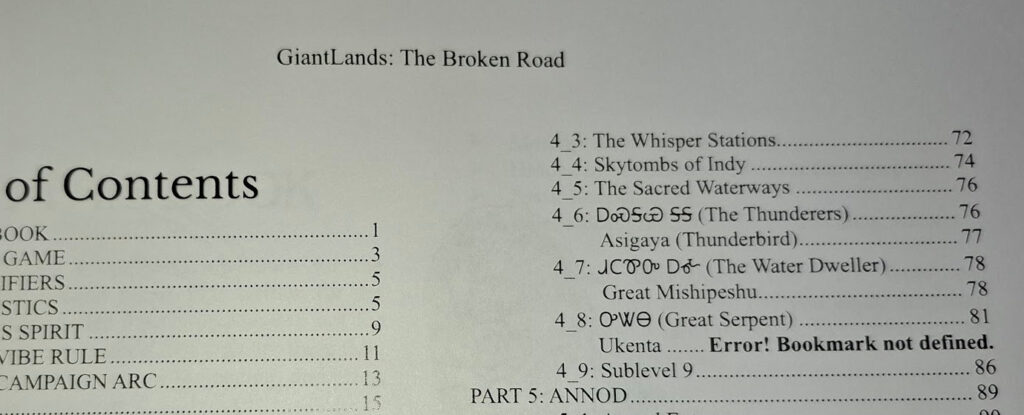
Penny Williams is listed as the Game Editor but since the summary of rules at the start leads almost identically to the AI slop that I’ve seen in other products, I can only assume that Dinehart did massive re-writes or opted to ignore her notes. ⬆️
B. What about the world building?
Pretty simply… there is none. Or rather, what there is contradicted in the GiantLands core rules, or Tuskaloosa’s Reckoning or other areas of The Broken Road.
The town of Mot is theoretically fleshed out, but simply does not have the details that you’d want to know for a home base. You know the name of the chief, the brewer/bartender, the local urchin and there is a job delivering water daily but you don’t know: where does their food come from, what kind of values do they uphold, what are they working towards, what at their traditions? Where does the chief’s authority stem from?
You don’t really find out any sort of cultural aspects until the Indy part, and even that is impossible to put into context of a regular mortal who doesn’t expect to meet Uktena in person.
Most importantly, while there is a whole section saying that it explains the cosmology of GiantLands it is confusing and incomplete. Sure it’s find to say there’s three pantheons of gods and they have manifestations in the world, but what about Gaea? What about the cosmology of the oft mentioned Manquatti? Of the off-world Andros?
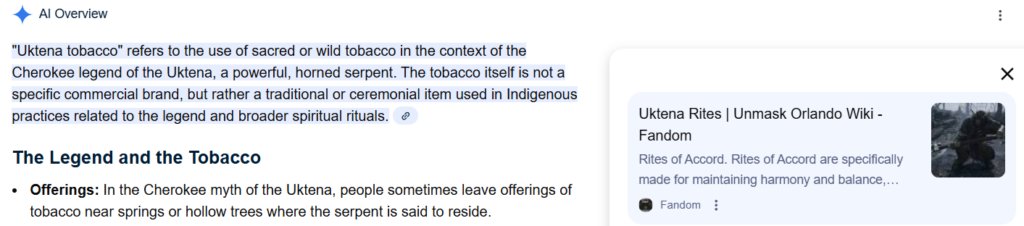
Why is tobacco mentioned as an offering to Uktena but only for when you meet a manifestation in person? This one is particularly worrying, because I tried to investigate this and Google Gemini AI cheerfully volunteered to me it was a thing… and sited a fucking World of Darkness game wiki.11 “Uktena Rites” (Unmask Orlando, Fandom) <unmask-orlando.fandom.com/wiki/Uktena_Rites>
These details are important, not just for the need to respect real living people but because it’s very difficult to imagine yourself in a world like GiantLands without these kinds of scene setting details. You’re in a world where supposedly people don’t have electricity or computers, but you have robot people, energy weapons, hovercraft, space ships and both Ley magic and Ley technology.
Without the worldbuilding of the foundation of the day to day life, it becomes impossible to understand what is and isn’t available to a player, what is unusual in the scene before them, what are the options that ordinary and extra-ordinary people could consider.
The problem for Dinehart seems to be that none of that is “epic” and it would require a lot of him doing actual research, careful consideration, etc.
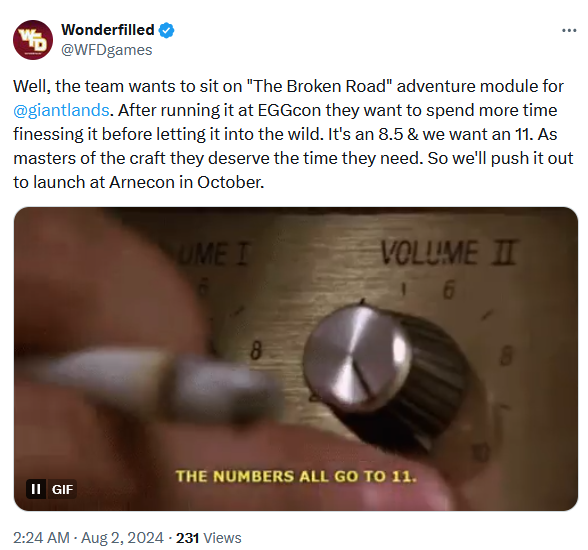
Instead he’s opting to just spam you with epic moments and expect you to imagine the rest of the world for him. ⬆️
C. It actually diminished GiantLands
On top of the issues above, which obviously showcase some serious problems – the module actually diminishes the viability of GiantLands and highlights why you, a regular table top role-playing game player, do not want to play it.
The premise of GiantLands is supposed to be healing a world after a cataclysm, helping nature flourish and reclaim the world again as well as helping civilizations that live in harmony with that idea to flourish. But the opening module seems to show that even the creator doesn’t want to do that or focus on that.
If Dinehart can’t write a basic module about the core premise without going on weird detours, deciding it was easier to let generative AI write it for him and can’t settle on a premise, then why should anyone else believe it has value? Why would anyone want to play a game he doesn’t want to make.
GiantLands is a system where you have a wide variety of species, professions, mutations and potential Ley abilities… and none of that variety is account for or accommodated in the module. The overall trend in that players are discouraged from engaging with these concepts creatively.
This is a predictable problem, after all anyone who has run a high level campaign in any table top role-playing game – the more options that you give your players, the harder it is to anticipate what they might do and plan around it. GiantLands has made this an issue since session 1, and just doesn’t engage with it.
There’s also a noteable trend to regress… early posts of The Broken Road featured unique art for it the splash page, but instead Dinehart keeps reverting to the same handful of artworks he released during the brief period where GiantLands was “popular”.
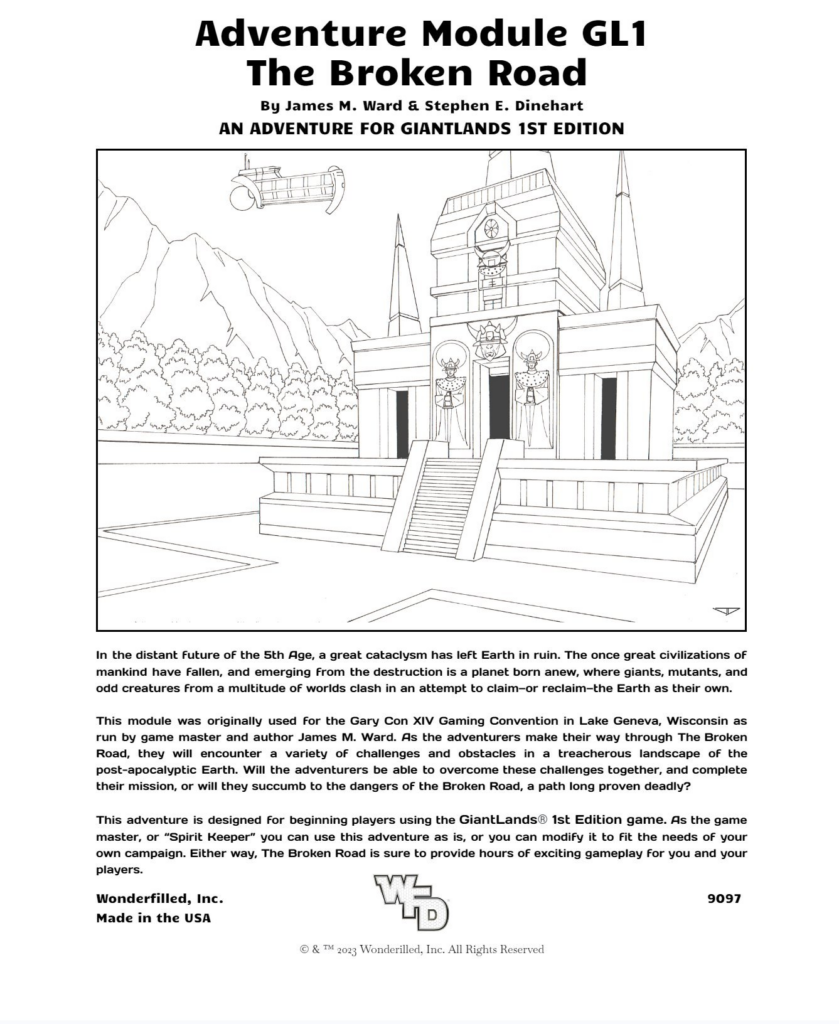
Lastly, if this is supposed to be a game showcasing the beauty of indigenous cultures in the Americas, this module sets it up terrible for that. It presents a bastardized word as though authentic, and approaches the mythology of living cultures not as a rich and diverse tapestry but a free ideas bucket which Dinehart can later rebrand as Cherokee and tie that back to himself.
I am not an expert on the politics of indigenous people in the Americas. I do not know if there are rivalries, disputes over origin, etc, but of this I am certain: Nobody benefits from Dinehart trying to enact a weird kind of colonialism where everything belongs to him first and Cherokee second.
This is the first module and the creator has already lost interest in the project, instead seeking it as a vector to market himself, his other projects and as a bucket to put AI slop in. He is routinely disrespectful to the cultures and the people it is supposed to involve. No critic can do the property more harm than that.
Also it’s self-published through Amazon Print-On-Demand, which essentially obliterates the idea that GiantLands is a master crafted game made to the highest standards so it can be a collector’s item. ⬆️
D. Why are these maps?
As covered in the blow-by-blow, there are numerous areas where a map probably would have helped but instead there are basically 4 maps. 1 is a completely useless map of Mot that shows nothing, another is a broad area map which has a legend that indicates it shows land altitude by colour… but it doesn’t do that.
The other 2 are the same map with different formatting, and its the one that showcases the up close area with the major areas marked, and the highways that make up The Broken Road as well. Using this, and the guide, we can map out the project route of the party and this ruined my life for weeks.
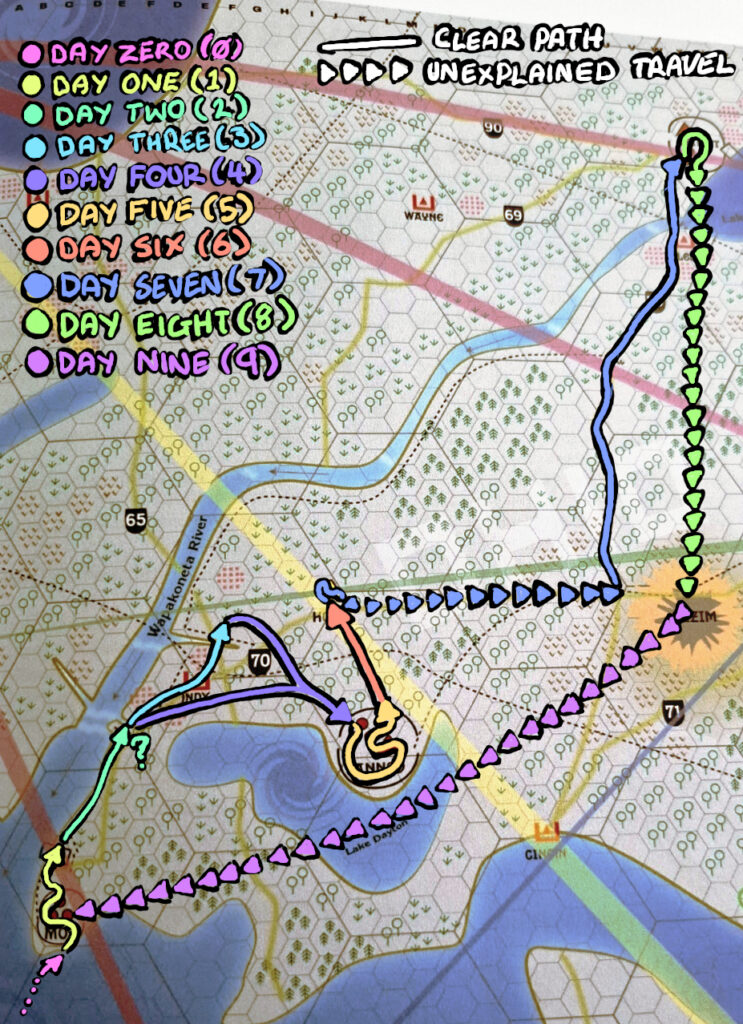
I can only speak for myself on this, but generally I find the process of making maps and picking out locations to be helpful in scoping out the adventure. Dinehart appears to have worked on both in complete isolation of one another – at least after Hopi.
This gets even worse when you realize that he seems to have imported his version of the weather mechanics in Rimworld but made them more extreme, with no actual thought about how these will fit with the setting. A tornado or a wildfire could be an interesting threat on an open plain, or even on one of the titular highways, but would have massive setting impact if it occurs in one of the major settlements. Heavy snow in a dense jungle is simply bizarre.
Also… I feel the need to point out that amongst the other lies on the product page is this:
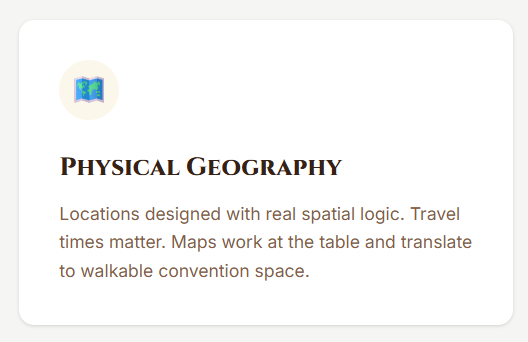
I can’t even. ⬆️
V. CREDITS, EXTRAS AND OTHER ISSUES
I’ve already covered the issue of the less than 1% Jim Ward, and a lot of the general issues… but of course there’s more. There’s always more. ⬆️
A. Credits
For most of the time that this module has been in the works, Dinehart has been an assistant professor at the University of Tampa. This is significant because among the other names he uses to promote himself, there are seven names I was able to trace back to the university, all recent graduates or honours students doing tutoring/other study etc.
None of them are old enough to know about the era in which games like Gamma World and Metamorphosis Alpha first entered the world. None of them are old enough to be seasoned creators, professional editors, etc. They are students because they have come to the university to learn the fundamentals of multimedia and interactive experiences.
I have not reached out to any of them, because I frankly can’t imagine how they would want to discuss this matter or otherwise be associated with it. But I am struggling to think of a way that this could be ethical, particularly given we’re already got the issues of passing off generative AI as writing, and crediting it to the late Jim Ward.
Oh, and the list of crediting artists who’s work-for-hire material was used as key contributors, which is also unethical. ⬆️
B. Extras and padding
After the module, which is arguably mostly padding, there are a few pages to pad it out further. Some new GiantLands monsters such as the incredibly creative Bigfoot, some blank map templates (ie hex grid) and some blank pages labelled “Notes”. Most puzzling of all, there is an advertisement for GiantLands. The game you need to own to play it.
Thankfully the promised Pooh Bears are not included, I guess he worked out eventually that only the version of Winne-the-Pooh who goes fully nude is in public domain, not the version that is identifiable as being part of the Disney adaptation.
But ultimately… it’s all garbage, but the biggest piece of garbage is the random tables. They have no context or instructions for their use, it’s just assumed you’ll work out how to do them.
There is a Random Mutations table which may be a substitute for the mutations available in the core rules, but if that’s so then there’s some major issues. 2 of the mutations simply let you become invisible at will, another lets you wild shape like a D&D druid – but with no parameters, another gives you claws but no rules for the ways they can help you with “climbing, digging or attacking foes”, another makes you stretchy like Mr Fantastic, another lets you see the future and another is…
Bestows the power to heal one [player character] 100% of Life. Force once a day, invaluable in dangerous situations. Roll below 50, or throw a coin and call it.
Also another that just lets you see the future, with no clear parameters and another that lets you teleport to any place you’ve been before. All of these are wildly overpowered and under written compared to the originals in the GiantsLands game.
I’ve been playing and running table top role-playing games for 25 years and I cannot for the life of me think how you would try to incorporate these into a game, and there’s certainly nothing in the material that helps you deal with it.
There is a Random Item table which includes a solar powered gun that instantly kills anyone. Seriously, there’s no damage etc, it just says it “fires blasts of searing heat at enemies, incinerating them in a single shot.” There’s also a serum that does an unspecified amount of healing and regeneration, and a serum that provides an unspecified amount of physical enhancement and emotional degradation.
Also bullets made out of radium, as in the things that they used to use in clocks and watches to make the glow-in-the-dark bits. I guess these would be helpful to the late David Hahn, but probably not anyone else.
Most offensive of all is the Random Sacred Item, which continues encouraging players to see indigenous culture as spiritual tourism and a gimmick to play with. It is also truly deranged as possible items are wildly variable, ranging from a dreamcatcher that gives you prophetic dreams, a feather than makes you brave and a healing crystal to a bow that shoots lightning, a cloak that lets you transform into a raven and shield that blinds people with the power of the Sun.
Apparently Dinehart only sees value in indigenous beliefs when they can be used as a substitute for a magic system or avoid him having to think of his own fantasy pantheon. ⬆️
C. Connections and impact
It seems in the years since Jim’s passing, Dinehart has decided to shift the focus of GiantLands less towards the game that Jim built and more towards his weird “setting” (which has no consistent information).
Since the release he’s revised the GiantLands to be more about Tuskaloosa’s Reckoning, his horrible AI book that is set to be his Bright. (📸 for context)
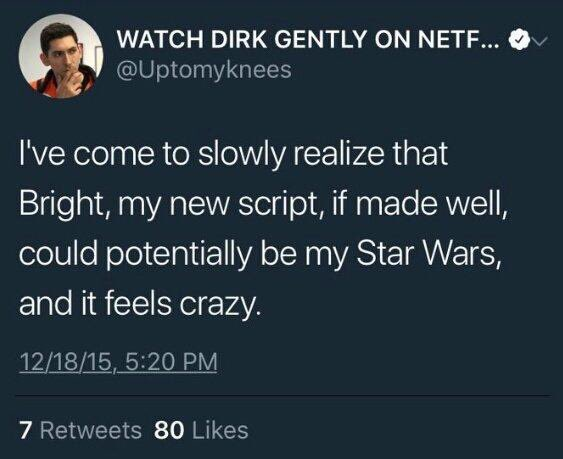
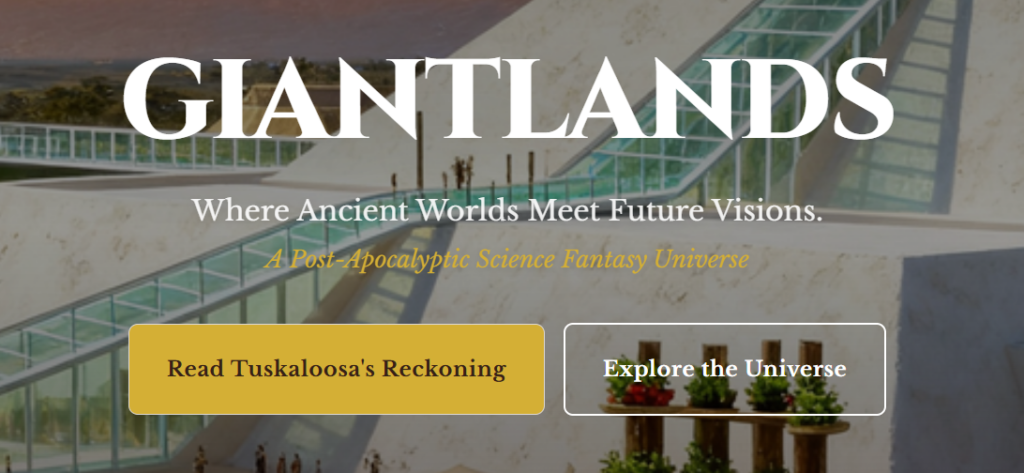
As it’s only available through Amazon’s print-on-demand, you have this weird scenario where you can only buy new flagship products via Amazon, but you can only buy the base product you need to understand it via the Wonderfilled site. Which hasn’t been updated, so still has the front photo of Jim and uses the AI slop cover to advertise The Broken Road
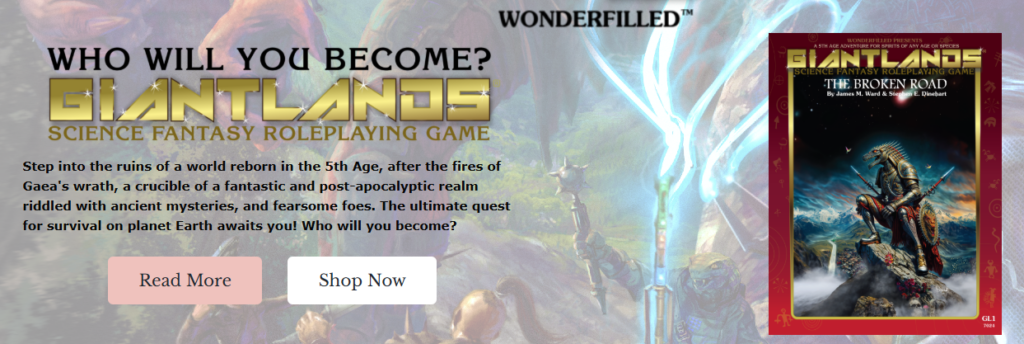
It doesn’t link you to a way to buy it, and depending on which Shop button you click on it may take you to a 404 page. Previously I asked What is GiantLands? and now the answer is:
- A boxed set game you can only buy directly from a man who may abuse your personal information if he takes issue with what you’ve said about it online; and
- 3 albums on Bandcamp there were originally all separate but now are together… no way to tell how they’re supposed to be linked
- 1 AI generated house music track that is available on multiple platforms (allegedly over 30) but not on Bandcamp
- 1 AI generated rip off of ancient mythology that is also cited in The Broken Road for no reason at all, so is GiantLands in the same way Argylle is Kingsmen
- An Amazon print-on-demand supplement that is not available digitally
- A novel that is available as print-on-demand or in Kindle format, and is intended to be the flagship
So if you purchased Tuskloosa’s Reckoning and wanted to know more (let’s just assume it was good, for this hypothetical) and you’re in a place that means shipping would be brutal (so anywhere outside the USA) you can buy the module and go on an adventure to try to find all the music, but you can’t buy the core product.
If you bought the core product because you want to support small businesses and local retailers, and hence forgo Amazon, you can’t buy the novel or the module.
This is the foundation that Dinehart wants to build a theme park, a multi-million dollar capital investment venture, upon. ⬆️
D. Revisions
By the time I got through reading it, taking thorough notes of the parts I felt were most relevant and writing this – Dinehart has already heavily revised the module. The typos on page 1 are fixed, the headings now have their own background shade, and the hilarious error on the contents page has been fixed… but its now contents pages as it flows over onto a 2nd page.
There’s other significant changes, the choice of Jeff Dee art on the inside splash page has changed (now it’s the alien walking out of their spaceship to be attacked instead of the party in front of a camp fire). The page count has gone up, apparently adding 14 more pages. A lot of changes seem to be distributed throughout the book.
There’s a new section to add “The Oracle of Sublevel 9”, possibly indicating a full re-write of the Jim Ward section to try to hide his sins or possibly just reformatting. Sir Bassalot is now (Knight of Groove) and it seems he meets the party in Hopi to take them to Detroit.
But there’s still plenty of major problems with it, page 5 features the actions that a person may do in a single combat round and these include:
- “Move up to their movement speed and take one action” (there is no movement speed in GiantLands)
- “Attach with a weapon or cast a spell” (no spells in GiantLands, they have ley abilities)
- “Drink a potion or activate a device” (no potions in GiantLands)
This section in the front of the module is, in an odd way, also an attempt to revision GiantLands, adding systems for Vibes (the karma from Fallout), Weather, etc. Far from being the a traditional “play at home with your friends in person” the whole GiantLands property is essentially brining the “games as a service” model to TTRPGs.
Ultimately, all this does it put it in the same category as Goblinz: Those Pesky Goblinz: A Role-Playing Game by Justin LaNasa as a product with an unclear number of distinct editions all labelled as the original, altered quietly in response to critics (mostly me, I think) pointing out hilarious errors.
No amount of revision is going to fix it though, because the core module is completely unworkable and the only way to create a workable version would be to start again and actually do the work. The one thing that Dinehart is unwilling (and likely unable) to do.
For all his bluster about being the ultimate Narrative Designer, he can’t even make the core plot points line up with the map they’re explicitly focused about, and lacks the discipline to keep his module focused on a single, coherent story for the players. He cannot revise his way to a good product until he commits to learning how to make a good product, and he won’t do that because then he’d have to admit he needs to learn. ⬆️
- 1Stephen Erin Dinehart IV “Tuskaloosa’s Reckoning: The Sun Sword: Part One” (Wonderfilled Inc via Amazon Print-On-Demand, Lake Geneva WI, 2025)
- 2Stephen Erin Dinehart IV & James M. Ward “GiantLands” (Wonderfilled Inc, Lake Geneva WI, 2021)
- 3James M. Ward & Stephen Erin Dinehard IV “GiantLands: The Broken Road” (Wonderfilled Games via Amazon Print-On-Demand, Lake Geneva WI, 2025)
- 4Vincent Florio “The Cult of Abaddon” (TSR LLC, Lake Geneva WI, 2022)
- 5Jennel Jaquays with a 5E Conversion by Scott Moore “The Caverns of Thracia: A Fifth Edition Conversion & Classic Homage” (Goodman Games, 2024)
- 6Stephen Erin Dinehart IV “GL1 The Broken Road Giantlands Adventure Module (PREORDER)” (Wonderfilled Games Shop, Wonderfilled Inc, Lake Geneva WI, 19 June 2024) <archived>
- 7Stephen Erin Dinehart IV as Professor Prism “Detroit Booty Temple: Temple of Booty” (Wonderfilled Inc, Lake Geneva WI, 2025) <templeofbooty.com>
- 8“Tabletop Session 1: GiantLands GL1 “The Broken Road” with James Ward 12/10/2022″ (GiantLands, YouTube, 10 December 2022) <https://www.youtube.com/watch?v=4UzyKW6ESZ8>
- 9Robert Lewis “Traditional Cherokee Story: Uktena and Thunder” (Cherokee Nation, YouTube, 13 July 2024) <https://www.youtube.com/watch?v=7DsA30UeaIg>
- 10Tim Kask (Tim Kask (Kaskoid), Meta née Facebook, 19 March 2024) <facebook.com/tim.kask.9>
- 11“Uktena Rites” (Unmask Orlando, Fandom) <unmask-orlando.fandom.com/wiki/Uktena_Rites>
One thought on “The Broken Road (2025)”